Brand is demand in B2B.

If you suspected they were never really separate, you were right.

There’s an uncomfortable mismatch at the heart of how B2B marketing budgets are typically constructed, one that doesn’t hold up well under scrutiny. A common assumption is that activating paid media against the right audience and the right pain point will be enough to generate meaningful demand. LinkedIn campaigns, display advertising, outreach sequences: these are the tactics that absorb the bulk of most marketing budgets, and they’re treated as demand generation almost by definition.

What this misses is that by the time the vast majority of buyers are ready to make contact with a vendor, the decision about who they want to work with has already been made. The real influence happened earlier, at a stage the majority of budgets simply weren’t present for.

Which raises a question worth sitting with: is there a fundamental misunderstanding, across the industry, about where the conversion point in a B2B purchase actually lies?


Built for the product, not the market.

As an industry, we plan for the whole customer journey. Strategies account for the full arc of a B2B buying cycle, including the extended brand-building activity that notoriously long sales cycles require. When it comes to activation, though, those longer-term elements are often quietly shelved in favour of paid channels, outreach sequences, and bottom-of-funnel tactics that are quicker, cheaper, and easier to evidence in reporting.

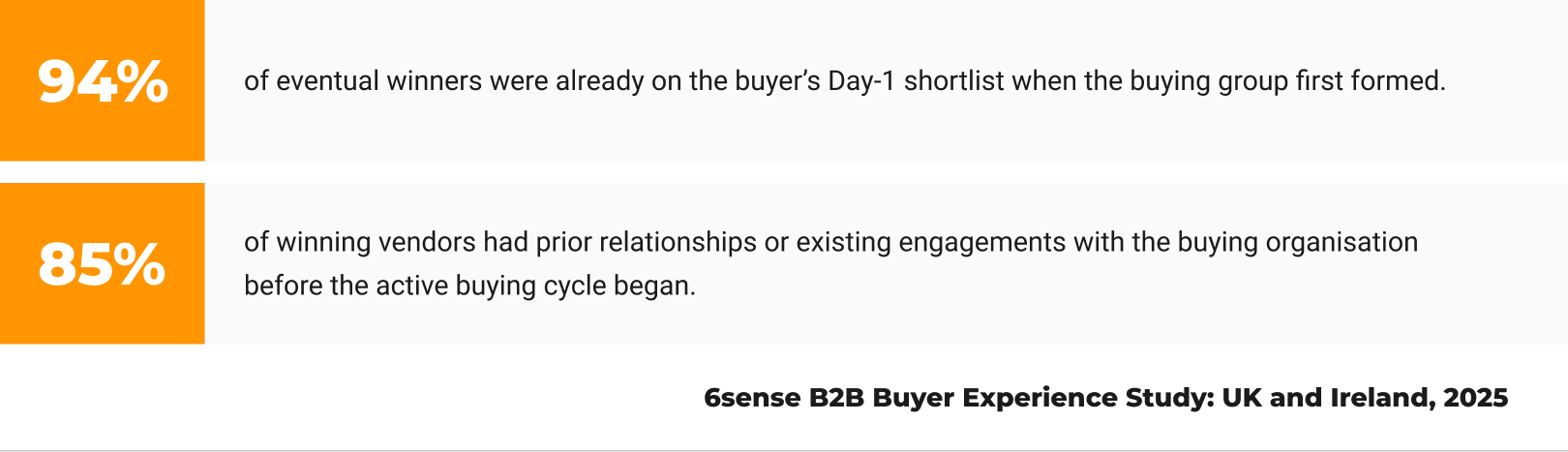
What the data consistently shows, however, is just how far upstream the critical decisions are taken. Two figures illustrate this.


Frame 29


What this means in practice is, in the vast majority of cases, the winner has already been chosen before any contact is made with vendors. If a buyer only comes across your paid media campaign while they’re in the latter stages of the journey, you’re effectively trying to reverse a decision that’s already been made.

This raises a more fundamental question about where conversion in B2B actually takes place. It also shines a light on how much budget is spent on trying to affect decisions that have already been made and won’t be reversed.


Everyone knows the 95/5 rule. Almost nobody budgets for it.

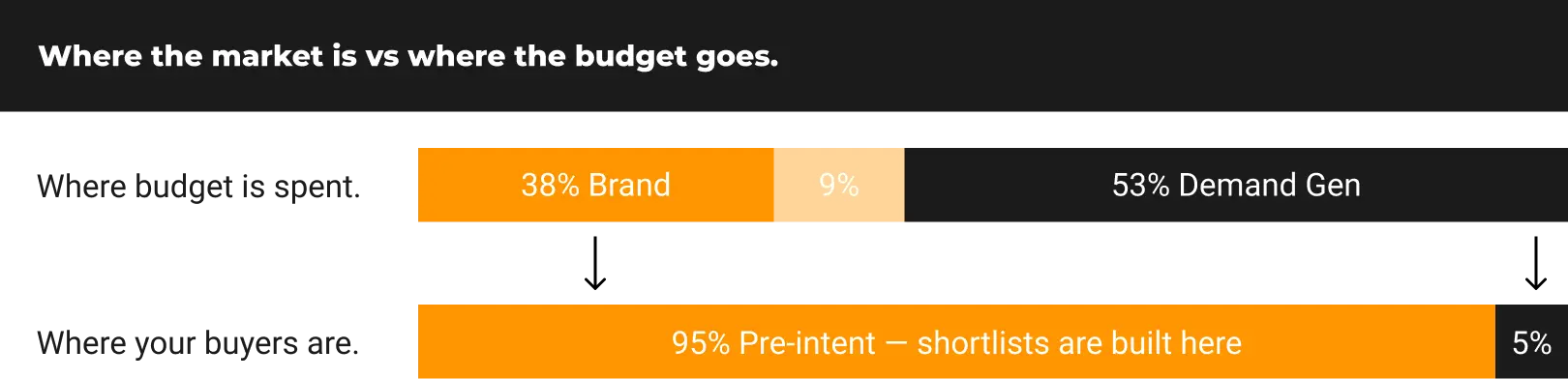
Almost all marketers can tell you the 95/5 rule, which states: “At any given moment, only 5% of your addressable market is actively buying. 95% are in a different part of the cycle.”

What the 95% are doing, throughout that extended period, is forming opinions, reading content, hearing names, and developing a sense of which companies seem to understand their world. The crucial thing is that this is where those all important Day-1 shortlists are actually built, often months or even years before a purchase initiative formally begins (6sense, 2025).

The problem is that budget allocation tells a very different story. Vendors spend 53% of discretionary budget on demand generation and just 38% on brand (TrustRadius, 2025), and among individual marketers, 49% rank lead generation as their top priority for 2026, while brand awareness is cited by just 21% (CoSchedule, 2026).


Where vendor budget goes vs where market generally is.


It is entirely rational for teams to prioritise what produces a visible result, especially when reporting cycles are 30 days and buying cycles are now averaging 272 days (Dreamdata, 2026). Brand investment is much harder to defend in a monthly pipeline review, and the incentive structures most marketing functions operate within make short-cycle thinking the path of least resistance. Most people in the room already know this. What the data suggests is that the cumulative effect of those rational individual decisions is quietly undermining commercial outcomes across the industry.


“You wouldn’t ask someone to marry you on the first date, and you shouldn’t ask a cold audience to book a demo on the first ad impression either. Over those 272 days, your job is to build familiarity, earn trust, and stay top of mind so that when that once-a-year buying window opens, you’re already the company they want to talk to.”

Dreamdata / LinkedIn Ads Benchmarks Report, 2026


This is not a marketing problem in itself. B2C brands have long understood that purchase decisions are driven as much by emotional connection as by rational evaluation, and have invested in brand accordingly. B2B has been slower to adopt the same approach, partly because there is an assumption that the buying process is more rational, and partly because the payoff horizon is long enough to be difficult to defend in a quarterly conversation.


Getting on the Day-1 shortlist is the real conversion event.

When we talk about Demand Generation, it’s often framed as a mechanism for creating commercial opportunities, with conversion happening somewhere downstream (a form fill, a discovery call, an RFP response). But if most winners have already been decided way before that stage in the journey, hasn’t the conversion already happened?

The argument is straightforward: getting onto the Day-1 shortlist is so consequential that it’s your activities in building brand authority that are creating your opportunities. Everything else lower down the funnel is just closing the deal.

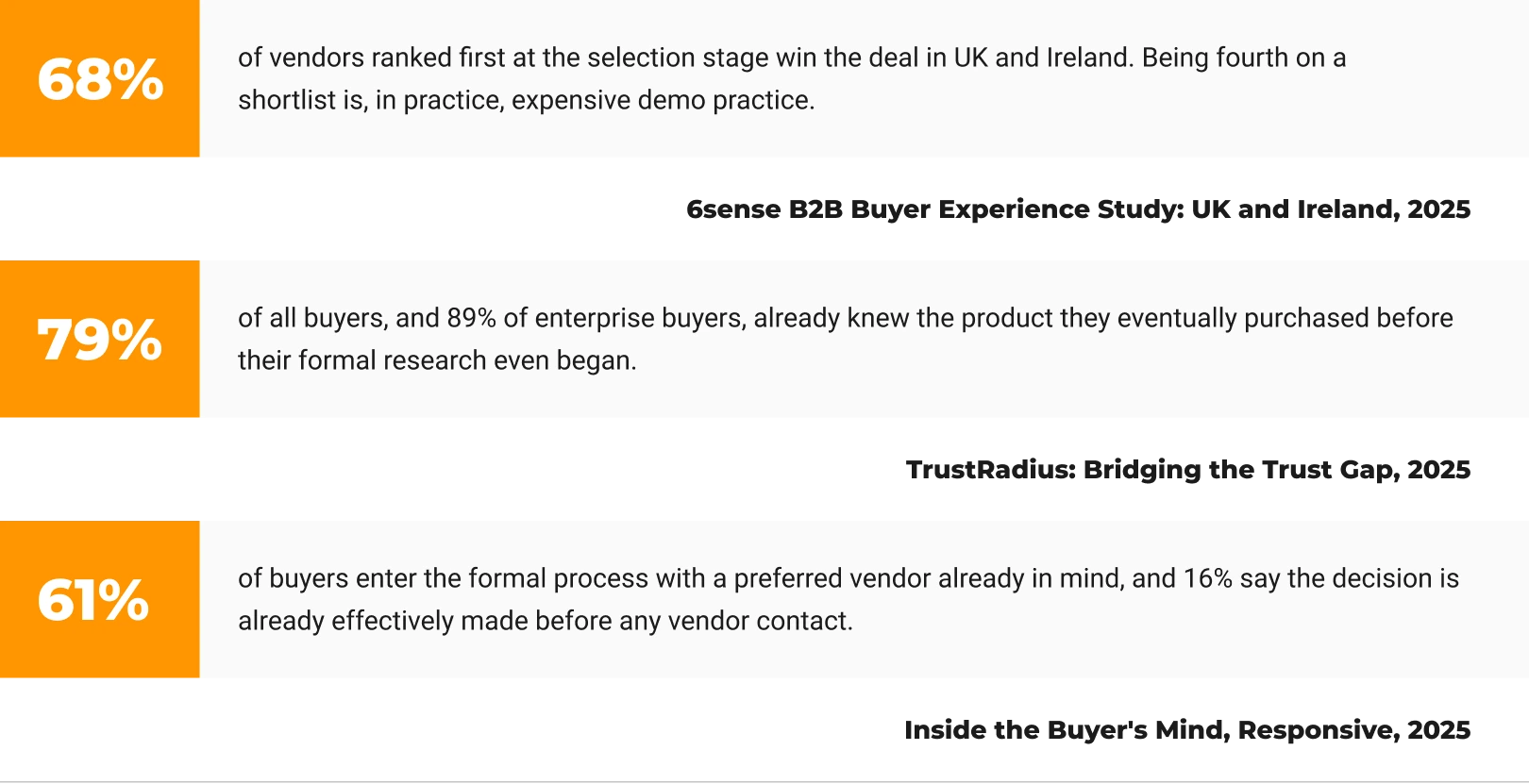
The numbers make this difficult to ignore.


Day 1 shortlist stats


The pattern is consistent across every data set. Buyers are not discovering vendors and then deciding. They arrive at the formal process with preferences already formed, shortlists already set, and in many cases a preferred vendor already identified. The active buying cycle, the part that CRMs capture and sales teams report on, is largely a confirmation exercise rather than a truly open competition.

For UK and Ireland buyers specifically, the first 57% of the journey, roughly 4.5 months in an 8-month cycle, happens entirely without vendor contact (6sense, 2025). Buying groups are forming, requirements are being written, and shortlists are being created and ranked, all before a brand knows the opportunity exists. A brand that is not already known during this phase is simply not being considered for the list that will determine who wins the deal.

Mid-funnel and late-funnel tactics are still important, but the reality is that they should be understood as closing tactics rather than demand generation. The demand was created, or lost, long before they were deployed.


“Deploying classic ‘demand generation tactics’ without effective prior brand presence is essentially fishing in water you haven’t stocked with any fish. At which point, it doesn’t matter how sophisticated your rod is.”

Simon Batten, Strategy Lead, Invanity


Why building brand authority is key to getting on that shortlist.

Before getting into this, it is worth saying clearly: there is no single prescription here. For some businesses, brand authority is built at industry events and conferences. For others, it comes through the publications their buyers read, a podcast, or a consistent presence in the communities where their peers share ideas. What holds true regardless of the channel is the quality and relevance of what you put out into the market.

A crucial part of building brand authority is your content strategy. Before anything else, it needs to answer one question:

Does this give our audience something they will actually find useful?

Content that keeps a brand top of mind across that long pre-intent phase tends to do at least one of three things:

  • Makes someone’s job meaningfully easier
  • Challenges how they think about a problem they already care about
  • Gives them something genuinely worth sharing with their peers

This is always easier when you have done the foundational work: a defined brand voice, a clear market position, and a genuine understanding of where your product or service fits in your buyers’ world. Taken together, these give you something distinctive to say, and the clarity to say it consistently.


“It is possible to build brand authority just from an email newsletter, if it’s good enough. The point is you have to give people something that makes them stop and think ‘yes, this is worth my time.’ Everything else is just noise.”

Sam Hodgson, Head of Client Delivery, Invanity


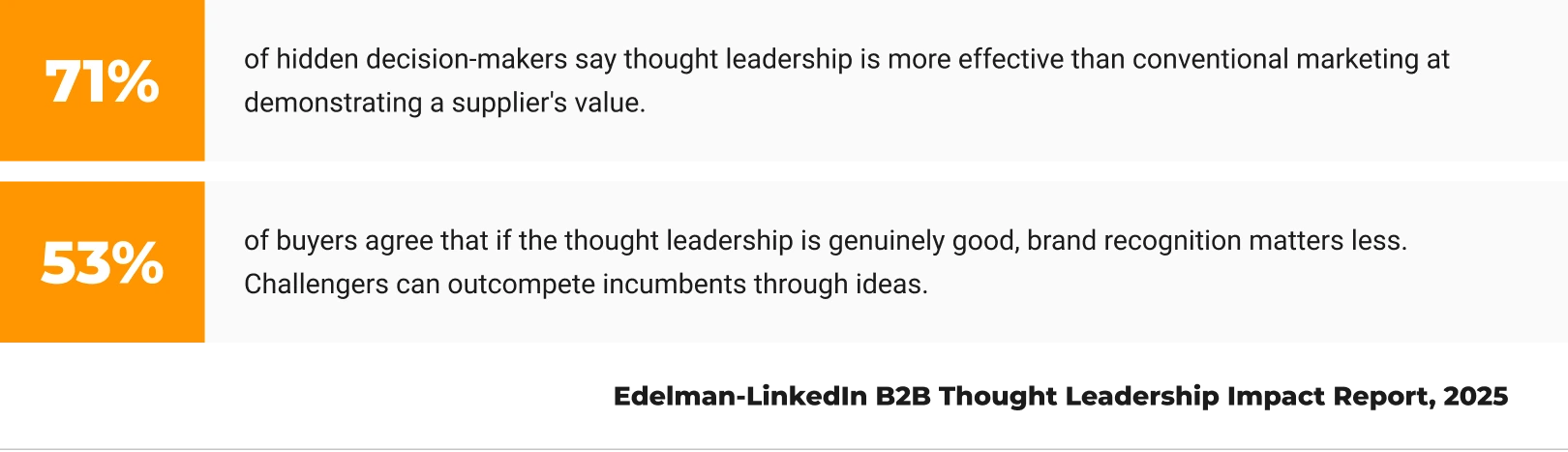
Buyers are more receptive to this than is often assumed. Strong thought leadership really does influence the buying process, demonstrating niche expertise to an audience that is actively looking for it. It also reaches members of the buying committee who are hidden from view; the finance, legal, and procurement stakeholders who will never take a sales call but frequently shape the final decision.
 

Stats 2 1


There is a discoverability dimension worth noting too. The authority signals that search algorithms and AI systems use to decide what to surface (such as clear expertise, credible sourcing, a consistent point of view) are unsurprisingly the same ones that earn trust from buyers in the first place. As AI-mediated discovery becomes a bigger part of how buyers research vendors, the brands that invest in genuine authority will increasingly be the ones that get cited, recommended, and found.
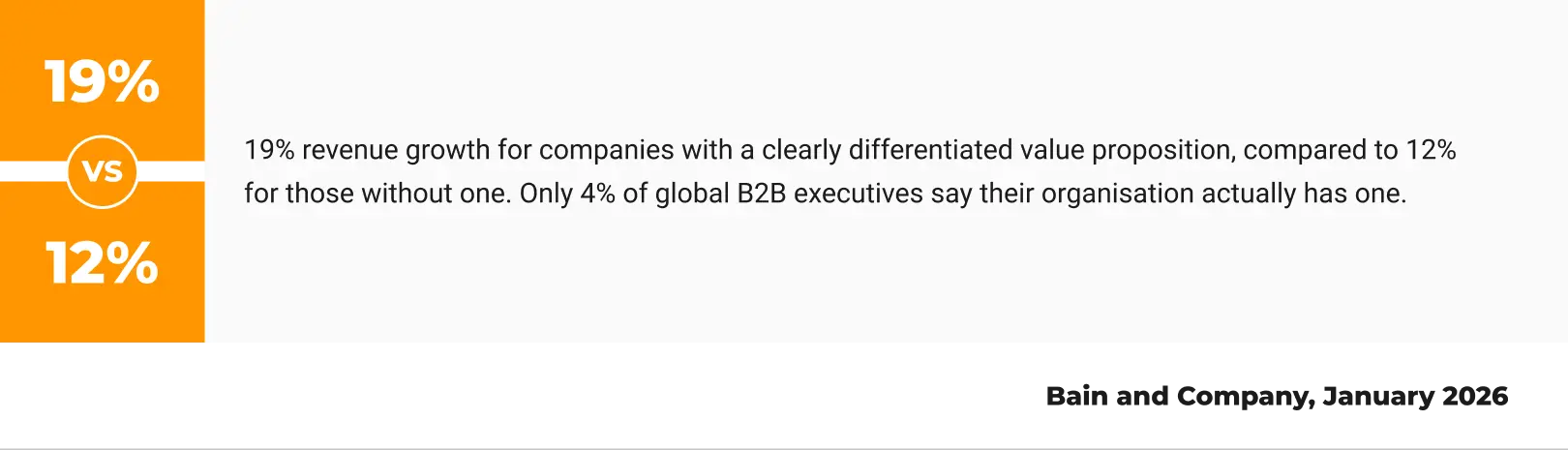
 

71% of hidden decision-maker say thought leadership is more effective than conventional marketing at demonstrating a suppliers value.


Of course, knowing that differentiation matters is one thing, having something that is actually different to say is quite another. This is where many brands stall, but also where the greatest opportunity sits. Closing that gap is less a creative challenge than a strategic one: it requires clarity about who you are, what you stand for, and what your audience needs to hear from you.

 

Bringing it together.

The data tells a consistent story. Commercial opportunity forms long before a buyer contacts a vendor, in the months and years when they are building opinions, consuming content, and quietly assembling their shortlists. By the time your paid campaigns find them, most of those decisions have already been made.

Getting on the Day-1 shortlist is the conversion event. Everything that follows is how you close what brand has already made possible, and the two deserve to be understood that way, as complementary parts of the same process rather than competing claims on the same budget.

The question for most marketing teams is not whether this is true. Most people in the room already suspect it is. The question is whether the way you plan, invest, and measure reflects it.

Simon Batten
LinkedIn

Simon Batten

Simon turns commercial ambition into marketing strategy. He works across the full strategic range, from positioning to multi-channel GTM and ABM campaigns. His specialism is making complex markets simple to navigate and building plans that connect brand to pipeline.