Your marketing ROI is great. So why aren’t you making any money?

For most agencies an 8x ROI looks like a win. And yet their clients routinely feel they’re not getting value for money. Most of the time, they’re right.

The reason comes down to profit margins. ROI tells you how many pounds came back for every pound spent. It doesn’t tell you how many the business kept. Those are different questions and most agency reports only answer one of them.

That’s one of the many reasons why we don’t report on ROI in the traditional sense.


The problems with ROI.

It can mean what you want.

ROI has never settled into a single shared definition. Ask what the “return” means and some marketers will say revenue, others profit. Ask what counts as the “investment” and you will get a similar spread, from media spend alone to an all-in figure that includes agency fees, staff time, media budget, and technology.

That inconsistency makes benchmarking difficult. When you look up a channel standard or category norm, the figures often reflect different underlying calculations rather than genuine differences in performance. And a term that is fluid is also one that can be shaped, whether consciously or not, to make performance look better than it is.

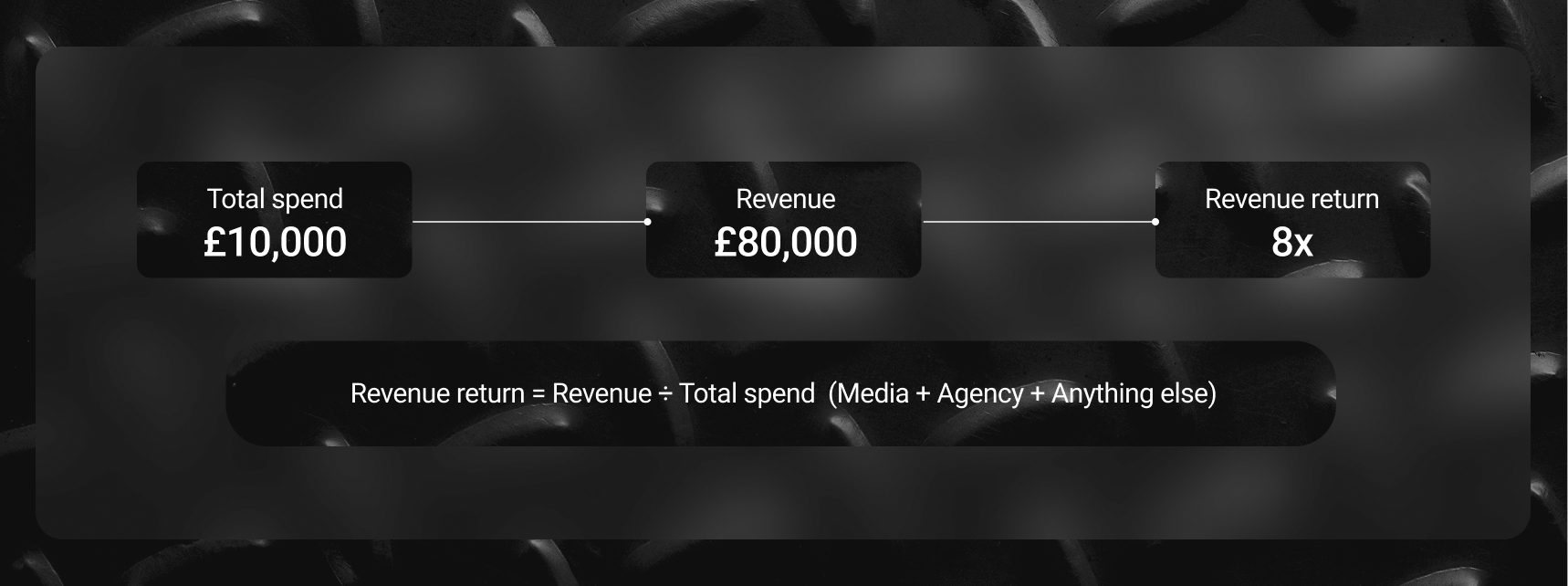
We report it as ‘Revenue Return’ (RR), which is total revenue generated divided by total marketing spend, combining both media and agency fees. This means a hypothetical campaign performing at 8x RR would generate £8 in revenue for every £1 of combined investment. Combined investment being the key point.
27 more conversions with AI Max. 1 1

It doesn’t tell the whole story.

That looks like a strong result, and most agencies would report it as such. The problem is it stops short of answering a really important question: how much of that revenue did the business keep?

The crucial consideration that we’re missing here is Profit Margin. For any number of reasons, this may be a figure that is not always readily available or simple to calculate, but where we have it, it gives us a far clearer picture of what the marketing activity is actually generating for the business.

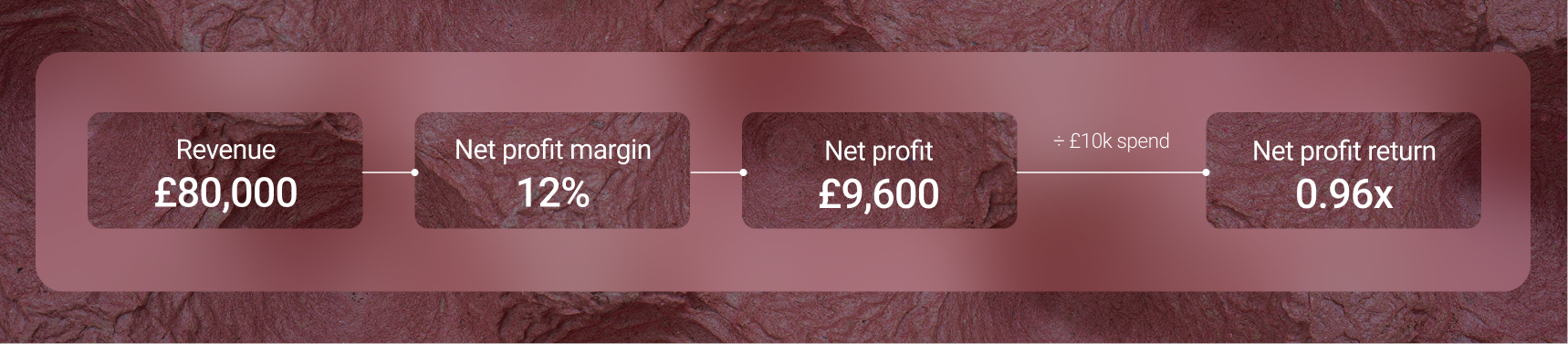
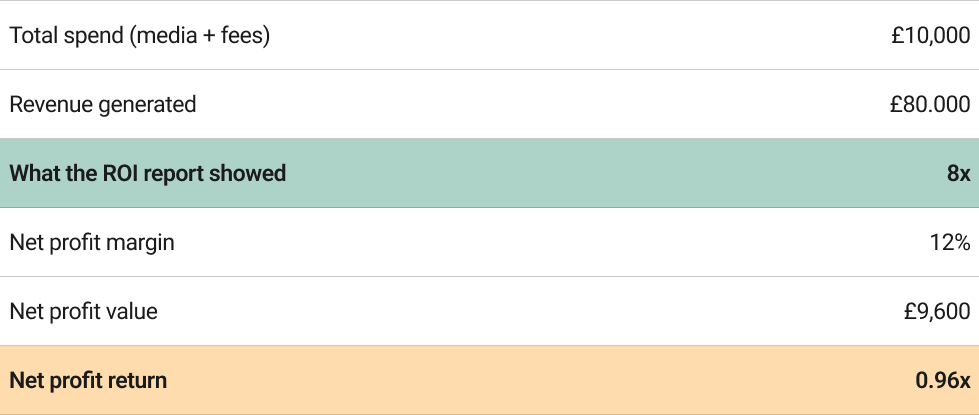
Remember that impressive 8x Revenue Return? Here is what happens when we factor in a slim 12% net profit margin.
27 more conversions with AI Max. 1 2

Here is how that plays out in a real client engagement:

An 8x ROI, that by most agency standards would be reported as strong performance, was generating less net profit than the campaign cost to run. In the most basic terms, it was making a loss. Once the margin was understood, the real target was a minimum of 9x just to reach commercial breakeven.


“Asking for a client’s margin can feel like a different kind of conversation to the one most agencies are used to having. But once you have it, everything downstream gets sharper. You know what a successful campaign actually looks like, you can set a target that means something commercially, and you have a much better basis for making honest recommendations about where the budget should go.”

Sam Hodgson, Account Manager, Invanity

 

Why this changes more than just the reporting.

The margin conversation doesn’t only affect how you present performance. It changes what you do with the budget, and it tends to surface things that a standard Revenue Return report would never show.

Not all products carry the same margin, which means campaigns should be optimised toward different targets depending on what they are selling. A campaign driving volume on a low-margin product line might need a 12x RR to be commercially justified, while a campaign targeting a higher-margin segment might deliver genuine business value at 4x revenue return. Without the margin layer, both campaigns look identical in a standard RR report and budget decisions get made on the wrong basis.

The same logic applies to channel selection. If Google Search appears to be generating a stronger return than LinkedIn, the obvious move looks like shifting spend toward Google. But if LinkedIn is consistently reaching higher-margin customer segments, a pattern that is quite common in B2B where seniority and job function often correlate with deal size and margin, the net profit picture may look quite different.


“The margin conversation also tends to surface things that were never going to show up in a standard report: which products the business actually wants to sell more of, which customer types are worth acquiring, and which channels are reaching the right people rather than just the most people. It reorients the whole programme around what the business actually needs.”

Luke Powell, Head of Operations, Invanity


This is consistent with what the research shows separates high-performing marketing functions from the rest. Google and BCG’s 2025 study on marketing measurement found that leading marketers, those who significantly outperformed their peers on revenue growth, were distinguished primarily by their willingness to align marketing KPIs with business outcomes rather than channel metrics. This creates what the research describes as a shared currency across marketing and finance. The mechanism that makes that alignment possible is understanding margin.

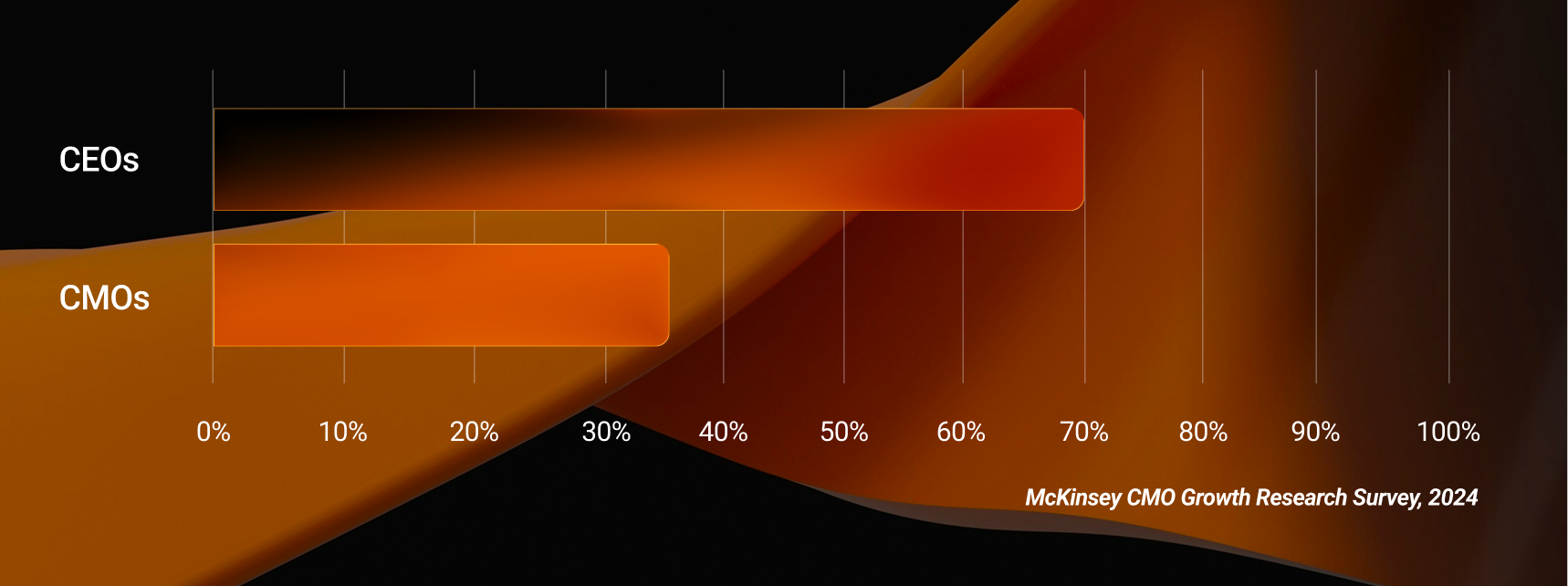
70% of CEOs measure marketing’s impact based on year-over-year revenue growth and margin.
Only 35% of CMOs track revenue growth and margin as a top metric. McKinsey CMO Growth Research Survey, 2024

27% more conversions with AI Max.


The attribution gap makes this harder, but not impossible.

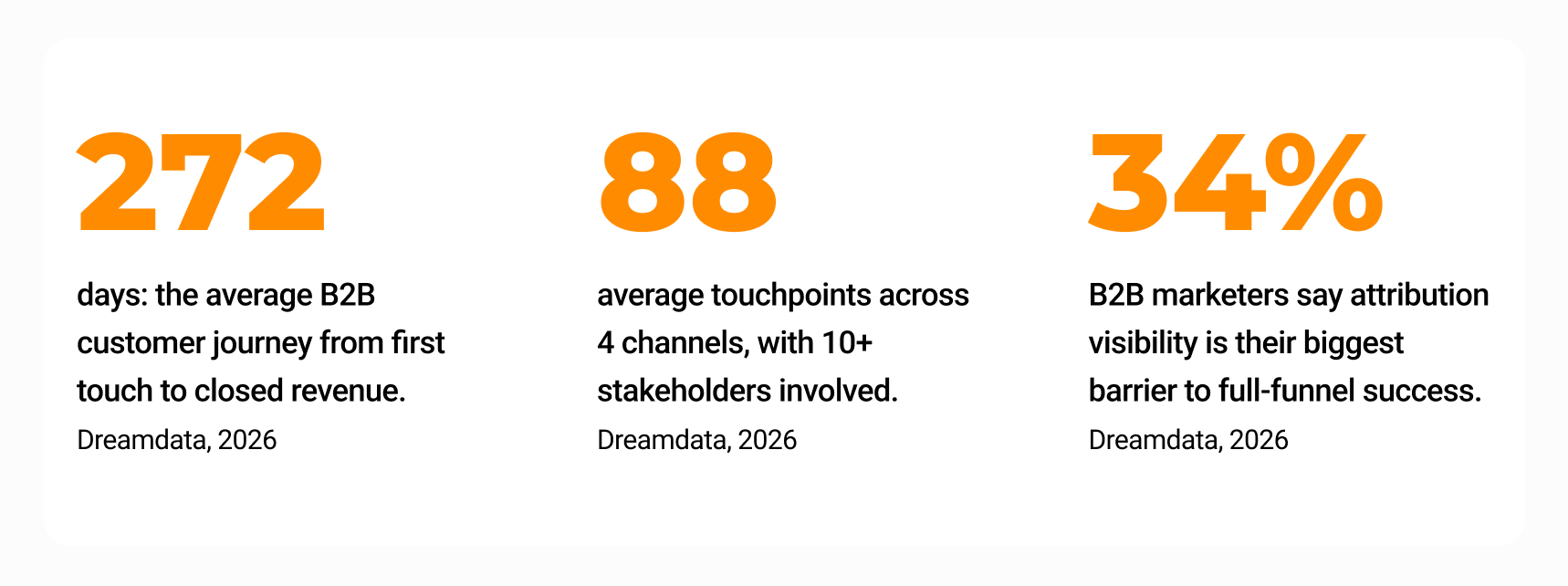
There is a reason most agencies don’t report to this level, and it is worth being honest about. Connecting marketing spend to revenue is genuinely difficult, particularly in B2B, where sales cycles are long and multiple channels contribute to a single outcome. Dreamdata’s 2026 research found that the average B2B customer journey now runs to 272 days and involves an average of 88 touchpoints across four channels, with ten or more stakeholders involved. When the journey is that complex, the idea that any single channel caused the deal is an oversimplification.

The attribution gap makes this harder, but not impossible

Our position is that contribution analysis is more honest and more useful than single-touch attribution in most client contexts. We ask which channels are generating the leads and pipeline we can observe, which channels are creating the conditions for other channels to perform, and how budget should be allocated to reflect the full picture, rather than only the final click. Net Profit Return, calculated at the overall campaign level, does not require perfect attribution to be meaningful. It requires revenue data, margin data, and total spend, all of which are knowable.

We’ve written more on why this shift is happening: Attribution in a changing user journey.


“We have seen businesses with strong ROI figures who are genuinely puzzled about why growth feels so hard. The answer, almost always, is that the reported return and the actual profit are telling different stories. Once you see the margin layer, you cannot unsee it.”

Simon Batten, Strategy Lead, Invanity


A reporting standard that reflects commercial reality.

There is an argument that taking reporting to this level creates exposure for an agency. If the Net Profit Return is below 1x, there is nowhere to hide, and the numbers say what they say. We think that is precisely the point. Clients who see Net Profit Return in every report understand, in concrete terms, what their marketing investment is producing, and that transparency creates a different kind of relationship to the one built on ROI charts and green dashboards. It creates the conditions for honest conversations about targets, about channels, and about whether the current strategy is the right one. After all, a client may be happy with a 0.5x Net Profit Return in year one if it supports long term brand building and desire creation?

The Profit Ability 2 report, which remains one of the most comprehensive studies of advertising ROI across sectors, makes a similar argument. The case for marketing investment should be built in the language that business leadership uses to make decisions, meaning profit, margin, and commercial return, rather than in the metrics that marketing functions find convenient to report. When 79% of business analysts say that brand and marketing is important in appraising a business, the implication is that marketing needs to speak the language of the boardroom.

Getting there requires one thing most agencies never ask for: the client’s net profit margin. It is a simple number, and most clients will share it readily when they understand why it matters. That conversation, which takes very little time, changes the entire basis on which campaigns are planned, targets are set, and performance is evaluated. The reporting that follows is more honest, more useful, and considerably harder to misread.

Sources
Dreamdata / LinkedIn Ads Benchmarks Report, 2026 | Google / BCG Global Measurement Survey, 2025 | Profit Ability 2: The New Business Case for Advertising, Thinkbox | Answer Engine B2B Thought Leadership Report, 2026


Jack Kennedy
LinkedIn

Jack Kennedy

Jack leads Invanity as someone who runs both campaigns and a business. That perspective shapes everything the business does: commercial outcomes as the measure of every marketing activity.