1. How can I make my website accessible to AI crawlers?
If AI crawlers such as ChatGPT can’t access your content, your site won’t appear in AI-generated responses – regardless of how good the content is. The fix is straightforward: ensure your technical SEO explicitly allows AI bots and makes your content easy for them to read.
Start by updating your robots.txt file to grant explicit permission for AI crawlers. This takes only a few minutes but can significantly improve your visibility in AI search. Add the following lines:
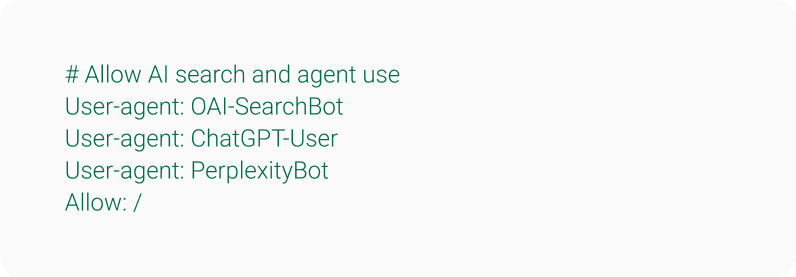
Beyond that, you’ll want to test AI crawlability using tools like Firecrawl, ensuring bots can access your critical content. Minimise JavaScript dependencies for important content – most AI bots struggle with JavaScript-heavy pages, so ensure key information is server-rendered or has a readable HTML fallback. Finally, review security settings to ensure AI-friendly search bots aren’t mistakenly blocked by overly aggressive firewalls or bot blockers.
2. How should I structure my content for AI?
Format your content with descriptive headers, front-loaded answers, and scannable elements like lists and tables. AI tools like ChatGPT prioritise content that is clear, well-structured, and easily extractable.
Use AI-friendly formatting:
Structure content with descriptive headers in a logical hierarchy (H1, H2, H3) that clearly signal what each section covers. Place answers at the beginning of sections – if you pose a question, provide the answer clearly in the first sentence. Use lists, tables, and bullet points to present steps, comparisons, and summaries in an easily scannable format. Break content into semantically complete, standalone passages that can be independently evaluated.
Create comprehensive, focused content:
Develop long-form content that thoroughly addresses topics, particularly list-based articles like “Top X ways to do a specific thing” – 74% of problem-solving queries generate AI overviews, and these formats answer them well. Cover related subtopics and questions that users might ask, using tools like AnswerThePublic and AlsoAsked to identify common queries. Ensure each section can stand alone as a complete answer to a specific question.
Write conversationally:
AI models are trained on natural language, so content that mirrors how people actually speak performs better. Use clear, concise language and avoid overly technical jargon unless your audience expects it.
Quick win.
Restructure your top-performing articles to include clear, direct answers at the beginning of each section, with the question naturally integrated into the response.
3. How should I use Schema markup?
Schema markup provides structured data that helps ChatGPT understand and contextualise your content better. Microsoft has confirmed that Bing uses schema markup to help its LLMs learn and understand content, and since ChatGPT Search is closely aligned with Bing, schema matters here too.
Priority schema types to implement:
Start with Article Schema for blog posts and news content – it helps AI understand publication date, author, and topic. Add FAQ Schema for questions and answers to make it easy for AI to extract Q&A pairs. Implement HowTo Schema for instructional content to clearly outline steps in a process.
For commercial content, use Product Schema for detailed product information including pricing, availability, and reviews. Add Review Schema to showcase ratings and credibility. If you have location-based services, LocalBusiness Schema is essential – it includes address, hours, and contact details.
Schema markup essentially translates your content into a language that AI systems can easily parse and understand, increasing the likelihood that your information gets selected for responses.
Quick win.
Implement FAQ schema on your most popular support and information pages to improve extraction accuracy.
4. What keywords should I target for AI search?
LLMs like ChatGPT are driven by natural language, which means you should focus on long-tail keywords that mirror how people actually speak. Traditional keyword strategies focused on short, exact-match terms, but AI optimisation requires targeting conversational queries.
Optimise for conversational queries:
Prioritise long-tail keywords that mirror natural speech patterns – typically 5 or more words. For example, target “how do I improve my website’s loading speed on mobile” rather than just “mobile page speed”. Phrase headers and titles as questions that users would actually ask. Write content in a conversational tone that feels natural to read aloud.
Use tools like AlsoAsked or AnswerThePublic to discover how people phrase questions in your niche. These tools reveal the actual language patterns your audience uses.
Target informational and problem-solving queries:
Research shows that long-tail, informational queries trigger AI responses more frequently than short commercial ones. Focus on queries like “how to,” “what is,” “best way to,” and “why does” rather than just product names or single-word terms.
Match user intent:
It’s not just about keywords – it’s about understanding what users are really looking for and creating content that provides clear, helpful answers. AI tools reward content that genuinely solves problems.
Quick win.
Use ChatGPT itself to simulate how people in your niche ask questions. Enter prompts like “What questions do people ask about [your topic]?” and then build content to match or improve on its current answers.
5. How does my traditional SEO impact ChatGPT?
Traditional SEO isn’t dead – in fact, it’s foundational for ChatGPT visibility. A study by Authoritas found a strong correlation between high Google rankings and mentions in AI-generated answers. Content that ranks in the top 10 positions on Google is far more likely to be referenced by large language models.
The higher your content ranks, the more frequently it gets cited by AI, creating a self-reinforcing cycle that strengthens visibility in future responses.
Maintain SEO fundamentals:
Demonstrate E-E-A-T (Experience, Expertise, Authoritativeness, and Trustworthiness) through well-researched content and clear expertise signals like author bios, credentials, and original research. Build relevant, authoritative backlinks from reputable sites in your industry. Target keywords that align with genuine user intent, not just high search volume.
Create comprehensive content that thoroughly addresses search queries. Optimise technical elements like page speed, mobile-friendliness, and Core Web Vitals. Keep content fresh with regular updates, current statistics, and relevant examples.
The link between traditional SEO and AI visibility:
Research from SE Ranking analysed 129,000 domains and found that the number of referring domains ranked as the single strongest predictor of ChatGPT citation likelihood. Sites with over 350,000 referring domains averaged 8.4 citations, compared to 1.6–1.8 for those with fewer than 2,500 referring domains.
Similarly, domain traffic ranked as the second most important factor, though the correlation only appeared at high traffic levels. Sites with under 190,000 monthly visitors averaged similar citation rates regardless of exact traffic volume.
Quick win.
Audit your top-performing content and add additional expertise signals such as updated author bios with credentials, original research or data, and current statistics to strengthen credibility and reinforce your authority.
6. How do brand mentions help ChatGPT visibility?
Here’s a critical insight from recent research: ChatGPT mentions brands 3.2 times more often than it provides clickable citations. This means brand mentions have become the primary way to achieve visibility in AI-generated responses, even more important than traditional backlinks.
Why brand mentions matter:
When ChatGPT generates an answer, it synthesises information from multiple sources and often mentions brands by name without necessarily linking to them. If your brand is consistently mentioned across trusted sources, ChatGPT learns to recognise you as an authority and includes you in relevant responses.
Build brand mentions across multiple channels:
- Discussion platforms are particularly powerful. Research by SE Ranking found that domains with heavy presence on Quora (6.6 million mentions) averaged 7.0 ChatGPT citations, versus just 1.7 for minimal presence. Similarly, domains with over 10 million Reddit mentions averaged 7 citations compared to 1.8 for those with minimal activity. Engage authentically on these platforms by answering questions, sharing expertise, and contributing helpful information – not just promoting your brand.
- Review platforms provide crucial trust signals. Domains featured on multiple review platforms (Trustpilot, G2, Capterra, Sitejabber, Yelp) earned 4.6–6.3 citations on average, compared to 1.8 for those absent from such platforms. Claim and verify your profiles, encourage authentic reviews from real users, and respond to feedback to build trust signals.
- Industry publications and roundups create valuable brand mentions that AI systems recognise. Getting featured in “best of” lists, comparison articles, and industry roundups increases your authority. Reach out to relevant publications and offer to contribute expert insights or case studies.
- Affiliate and aggregator sites are frequently cited by ChatGPT. The AI often sources recommendations from platforms like OpenTable, TripAdvisor, and PCMag when users search for “best” or “top” options. Getting featured on these sites dramatically increases your chances of being mentioned.
7. How can YouTube help my ChatGPT visibility?
YouTube is the single most cited domain for ChatGPT and other AI search engines. Even if videos aren’t hosted on your website, a well-optimised YouTube presence can significantly increase your chances of being cited in AI responses – particularly for tutorials, how-to content, product demos, and reviews.
Research shows that AI platforms overwhelmingly reference YouTube videos, despite having no apparent incentive to do so. This happens because videos combine rich, structured transcripts with visual demonstrations, making them ideal sources for AI systems answering complex queries.
Why YouTube matters for AI citations:
ChatGPT cites YouTube videos for several key reasons:
- Rich, structured information – Video transcripts provide detailed, conversational content that AI can easily parse and understand.
- Multimodal content – Videos combine visual demonstrations with spoken explanations, making them perfect for topics that benefit from both formats.
- High authority – YouTube is the second-most visited website globally, receiving approximately 48.6 billion visits per month. AI systems trust it as a credible source
- Query alignment – Videos naturally answer “how-to” questions in the exact conversational format users search for.
Create valuable, educational content:
Focus on producing videos that solve specific problems or answer common questions in your industry. AI favours in-depth, well-structured content over short, superficial explanations.
- Build series rather than isolated videos. Create series that cover a topic comprehensively – for example, a playlist on “Complete Email Marketing Guide” with separate videos on strategy, tools, copywriting, and analytics. This approach mirrors content cluster strategies that work on websites and builds authority that AI systems value.
- Use multimodal demonstrations. Walkthroughs, live product teardowns, interviews with subject-matter experts, and deep-dive commentary all signal expertise far more clearly than generic talking-head content.
Optimise titles, descriptions, and transcripts:
Write titles as questions or queries that mirror how people actually search. Instead of “Q2 Cloud Platform Updates and New Features,” use “How to reduce cloud storage costs by 30% with automatic tiering.” The first is corporate-speak; the second matches actual user intent.
- Descriptions should act as structured summaries that clearly state who the video is for, what problem it solves, and which key steps it covers. Think of these as content written for both AI systems and human readers.
- Enable and edit transcripts. YouTube’s automatic captions are a good start, but edit them for accuracy. Comprehensive captions serve both accessibility and AI optimisation – they help users watch in sound-off environments whilst giving AI crawlers richer text to analyse, reinforcing topical relevance and relationships that matter to citation systems.
Embed videos strategically on your website:
When you embed YouTube videos in relevant blog posts or product pages, add descriptive context around them. Use headers like “In this video, [Expert] explains how [solution] works” to help AI understand what question the video addresses.
- Implement VideoObject schema markup on pages where videos are embedded. This structured data helps search engines and AI systems understand the video’s content, duration, upload date, and relevance to the page topic. Schema markup is one of the acknowledged signals that influences AI citations.
The bottom line:
You don’t need to host video on your own site to benefit from it in AI search. A well-optimised YouTube channel can serve as a powerful citation source for ChatGPT, particularly for educational, tutorial, and explainer content. The key is creating quality videos that answer real questions, optimising them with proper metadata and transcripts, and strategically embedding them on your website with appropriate schema markup.