
“Google no longer just knows your video exists. It can reach inside it and pull out the answer.”
More from FrancescaWhat Ask YouTube reveals about Google’s understanding of video.
How Ask YouTube signals that video has become a knowledge source to be interpreted, not just media to be found.

Introduction.
Ask YouTube is more than a product update. It’s a signal – and if you’re paying attention to where search is heading, it’s one of the clearest ones Google has sent in years.
The hints have been building for a while. Videos surfacing in AI Overviews. Gemini citing YouTube content in responses. NotebookLM reasoning over transcripts. Each of those moments pointed in the same direction – Google wasn’t just indexing video, it was beginning to interpret it. But in each case, the capability stayed hidden inside the infrastructure. Users never saw it directly.
Ask YouTube changes that. It’s the first interface built around that capability explicitly – where video isn’t a reference pulled into a text-based answer, but the starting point. Users ask questions conversationally, receive structured answers drawn predominantly from video content, and get timestamped citations pointing to precise moments inside those videos. The interface isn’t organised around finding videos. It’s organised around extracting answers from them.
And that shift, from hidden capability to direct interface, has consequences for how video content gets built and optimised as it gives video a new position in the information hierarchy.
What does Ask YouTube actually do?
Ask YouTube is a conversational search interface, officially announced by YouTube on 27th April 2026. It was tested with US Premium subscribers (18+, English only) until 8th June, and has since opened to all signed-in US desktop viewers aged 13 and over. Type a question – not a keyword, a question – and the feature returns a structured response drawing on long-form videos, Shorts, and informative text, with timestamped links pointing to the exact moments relevant to your query. Follow-up questions are supported, so the experience is persistent and thread-based, not a single exchange.
The Verge’s Jay Peters tested it with ‘short history of the Apollo 11 moon landing’, and the result was telling. Rather than a list of videos, the page returned a structured summary of the mission, a timestamped video from the launch day, and curated galleries organised by theme: ‘From Launch to Splashdown,’ ‘Historic Footage and Behind-the-Scenes,’ a series of Shorts about ‘Moments on the Surface.’ The interface organised the knowledge. It didn’t just surface the videos.
The use cases span informational and planning queries alike – from factual questions to itinerary building – but the underlying mechanic is consistent: answers assembled from video content, surfaced as a response rather than a results list. Responses also incorporate informative text alongside video, so this isn’t purely video-sourced. Video is the primary input, not the only one. But the directional signal holds.
The UX detail that matters most isn’t the AI summary. It’s the timestamps. Google isn’t surfacing videos; it’s surfacing moments inside them, and there’s a reason that’s where the product landed. Research consistently shows declining attention spans, particularly for video. Most users won’t watch 45 minutes to find a 30-second answer. Ask YouTube is built around that reality. The interface doesn’t ask users to do the work of extraction. It does it for them.

What does semantic video retrieval mean?
For years, Google’s relationship with video looked a lot like skimming a book by its cover. It could read the title, the description, and the metadata, but the actual content remained largely opaque. It knew a video existed. It didn’t know what was inside it.
That changed gradually, and Ask YouTube is the clearest evidence yet of how far that shift has gone. There’s a meaningful difference between a system that scans a transcript for keywords and one that interprets what’s actually being communicated. Timestamped responses imply the latter. To surface a precise 30-second answer from a 45-minute video requires more than keyword matching – it requires scene detection, entity mapping, and contextual interpretation of what’s being said and when.
That said, this isn’t a clean handover. Early testing has already surfaced specific errors – during The Verge’s experiment, Ask YouTube incorrectly stated that the original Steam Controller had no joysticks, when it actually has one. What we’re dealing with is probabilistic interpretation, not verified reasoning. The system extracts and infers. It doesn’t always get it right.
What this means for SEO and video strategy.
If Google has spent years quietly building the capability to interpret video content, and Ask YouTube is the moment that capability becomes a direct user interface, the implications for SEO and content strategy are significant. This isn’t a future consideration. The shift is already happening. YouTube sitting at the top of AI Overview citations isn’t a coincidence; it’s evidence that video is already being treated as a primary knowledge source in AI-driven search. The question for brands and content teams isn’t whether this affects them. It’s whether their video content is built to capitalise on it.
Video as a first-class search asset.
Video is no longer just a discovery medium. Google can now understand what’s said inside a video, not just the title and tags around it, which means video now competes directly with webpages for informational searches. The gap between text and video, one machine-readable, one opaque, is closing fast. Ask YouTube is the evidence.
Teams that built their video strategy around views, watch time, and subscriber growth are working with the wrong frame. The question is no longer just ‘will this video get found?’, it’s ‘can the right answer be extracted from this video?’.
Moments over whole videos.
Google may increasingly surface precise clips and segments rather than ranking whole videos. What matters isn’t just whether a video ranks – it’s whether a specific moment inside it is extractable. This reframes what optimisation means: the unit of value is shifting from the video to the segment.
Brand authority on YouTube just got more meaningful.
The Apollo 11 example from The Verge showed Ask YouTube attributing content to specific channels with titles and channel details surfaced. So it’s not just about segment extractability – established, credible channels have an advantage here. Brand authority on YouTube could become an SEO signal in a more direct way than before.
Metadata still matters – but it may matter less.
Titles, descriptions, and thumbnails remain important for discovery and CTR. That floor stays the same. But semantic retrieval reduces reliance on exact-match tactics and keyword-heavy metadata. What a video is called matters less if Google can interpret what it contains.
Teams still doing metadata-only video SEO are already behind. Not because metadata is irrelevant – it isn’t – but because it’s no longer sufficient.
The AI SEO angle.
If AI systems pull from video as a knowledge source – across Gemini, AI Overviews, and conversational search – then extractability becomes the new visibility. This isn’t confined to YouTube or even to search. It’s part of a broader shift in how AI systems find and use information.
Content doesn’t just need to rank. It needs to be interpretable by AI at a conceptual level. Future visibility may depend less on whether content exists, and more on whether AI systems can extract value from it. That’s the AI SEO frame applied to video – and it’s a frame that most video strategies haven’t caught up with yet.
What this means for your video strategy.
The practical implications of all of this are more straightforward than they might seem.
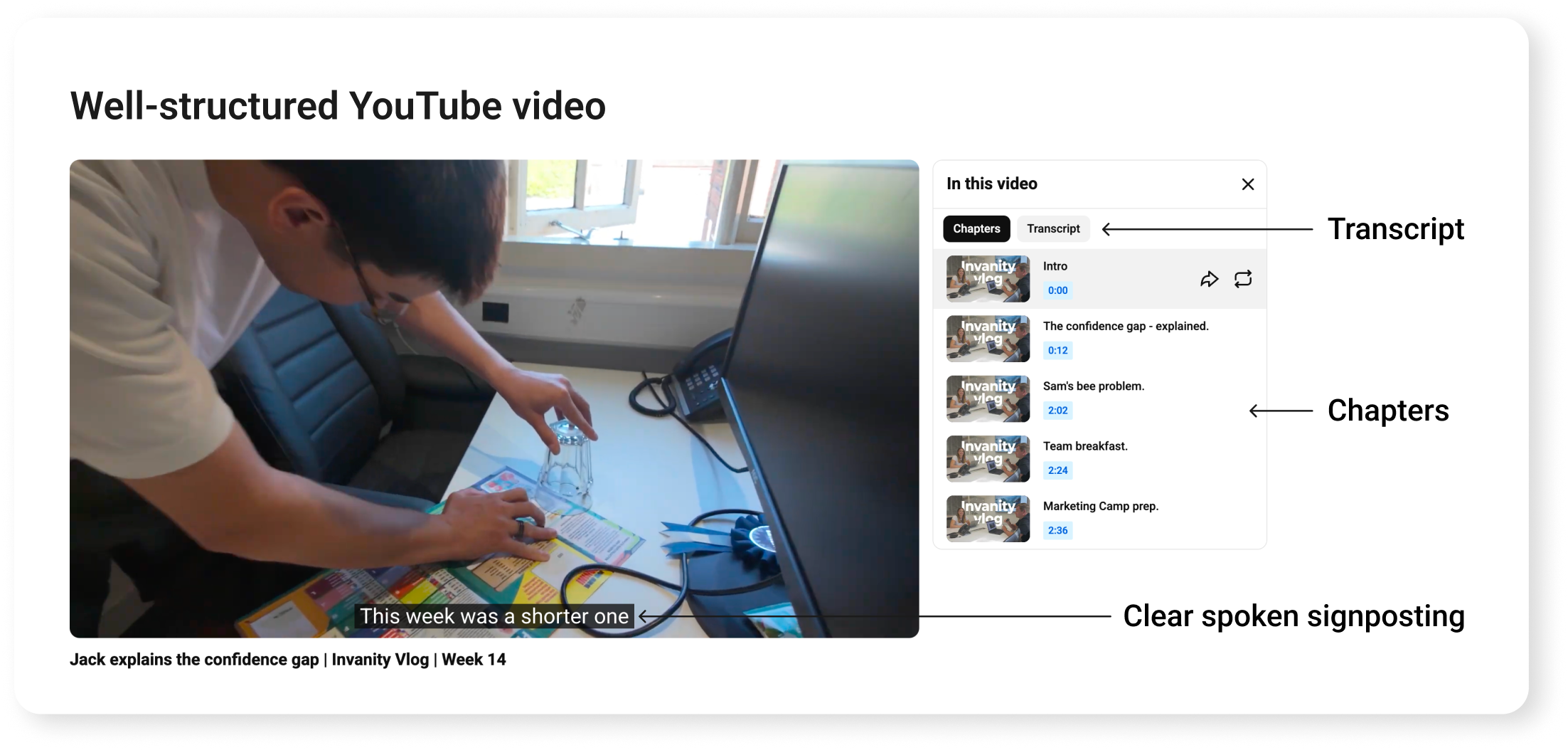
- Structure videos with clearly defined segments.
- Use explicit spoken language – state the point, don’t just imply it.
- Add chapters. Review transcript quality, especially if auto-generated.
- Think in terms of extractable insights rather than overall video performance.
There’s a broader context worth acknowledging here, too. YouTube’s audience is vocal about its dislike of AI-generated content – and rightly so. The brands that win in this environment won’t be the ones gaming the system. They’ll be the ones producing genuinely useful, clearly structured video that AI systems can interpret accurately and users can actually trust.
These aren’t nice-to-haves. They’re the new optimisation levers. A video that can’t be clearly segmented and transcript-verified is a video that semantic retrieval will struggle to surface accurately, regardless of how well it ranks by traditional metrics.
Video is knowledge to be interpreted.
Ask YouTube isn’t the end point. It’s Google confirming, publicly and in product form, that video has crossed a threshold. The system doesn’t just know a video exists. It can reach inside it, pull out the relevant moment, and deliver it as an answer to a direct question.
That confirmation matters. Not because Ask YouTube is the finished article, early testing shows it isn’t, but because it signals where the infrastructure is heading. Google has been building toward this quietly for years. Ask YouTube is the moment it stopped being subtle about it.
The brands that recognise that shift now and build their video strategy around it, won’t just perform better in search. They’ll be positioned for wherever AI-driven discovery goes next. The ones that don’t will find their content invisible, not because it doesn’t exist, but because it can’t be extracted.