
“You can't rank in ChatGPT. You can only be worth mentioning.”
More from FrancescaChatGPT SEO: How to get your business cited by ChatGPT.
How to make your content easy for ChatGPT to find, understand and cite – and why brand mentions now matter more than backlinks.

Introduction.
Search is changing, and ChatGPT is leading the charge. With 1 billion weekly active users and over 6.1 billion monthly visits, AI-powered discovery is no longer a novelty – it’s a new frontier for brands and websites. If your content isn’t being referenced or mentioned by ChatGPT, you could be missing a growing stream of visibility, traffic, and authority.
In this article, I’ll walk you through seven essential strategies to optimise your website so that it appears in ChatGPT’s responses. From technical accessibility to brand mentions, these tips will help you future-proof your SEO and become a trusted source in the age of AI.
What is ChatGPT SEO?
ChatGPT SEO – also known as Generative Engine Optimisation (GEO) – is the practice of optimising your content so it gets mentioned and cited by AI language models like ChatGPT. Unlike traditional SEO, where you optimise for search engine rankings, GEO focuses on making your content easily discoverable, understandable, and trustworthy to AI systems.
Here’s the key difference: Google ranks pages and displays them in a list. ChatGPT generates original responses and mentions sources it deems authoritative. Your content needs to be citation-worthy, not just keyword-optimised, and preferably written in a more conversational style, matching normal human communication.
ChatGPT pulls information from multiple sources, synthesises it, and presents a single, conversational answer. If your brand, product, or content is mentioned in that answer, you’ve achieved ChatGPT visibility. And unlike traditional search where users might click through several links, ChatGPT often provides the answer directly – making brand mentions the primary way to gain visibility.
The statistics are compelling:
- ChatGPT reached 1 billion weekly active users as of September 2026, up from 400 million in February 2025.
- 60% of US adults now use AI tools to search for information.
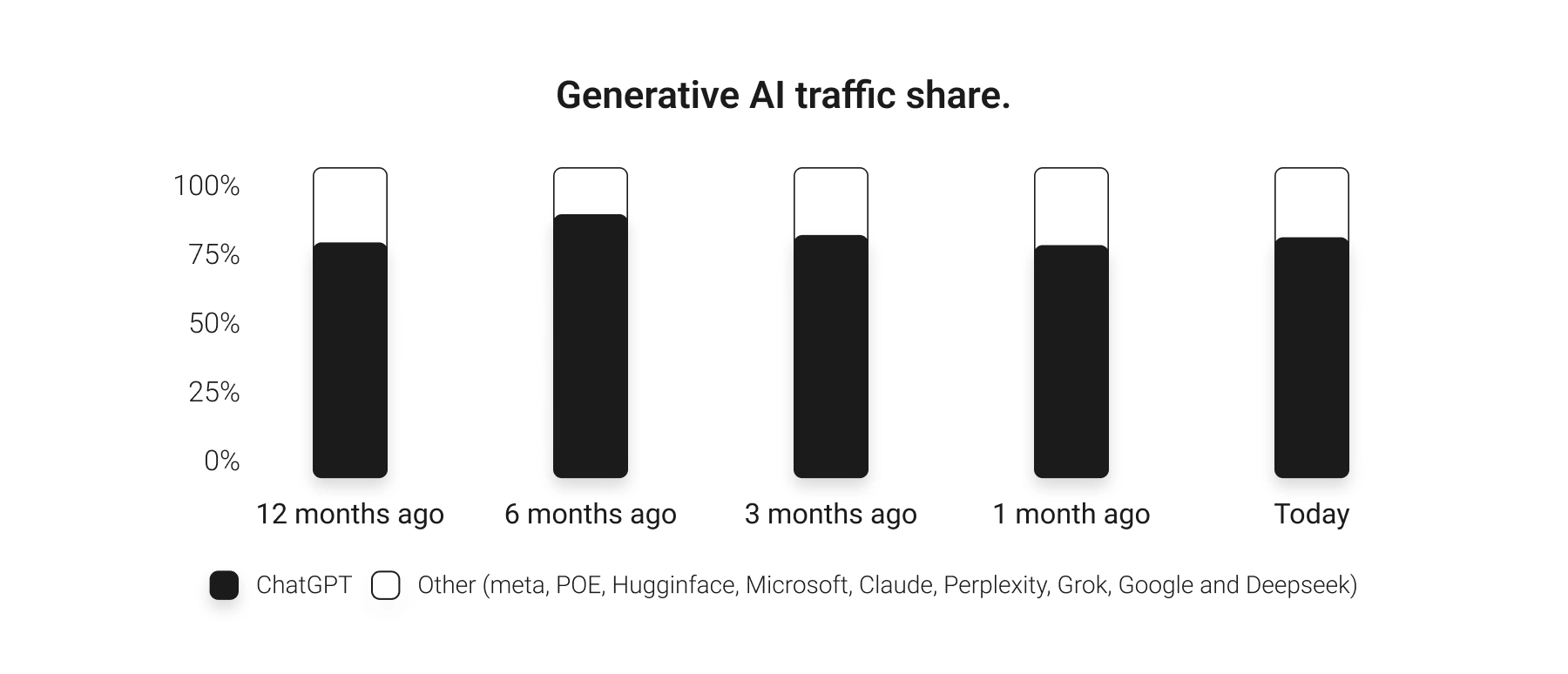
- ChatGPT commands a 79% share of the AI search market.
- AI search visitors convert at 4.4x higher rates than traditional search visitors.
This presents a unique opportunity: if ChatGPT can find, understand, and trust your content, it can supply you, or your information, as its answer – not just one among a list of links.
Why optimising for ChatGPT matters.
ChatGPT is more than a chatbot. With browsing capabilities, plugin integrations, and partnerships with major publishers, it’s becoming an AI-powered discovery engine. Users trust it to summarise, recommend, and cite websites directly in response to queries.
Research shows that ChatGPT Search results are 73% similar to Bing’s search results, which means traditional SEO foundations still matter. However, AI visibility requires additional optimisation that goes beyond conventional tactics.
The critical difference is where the buyer journey happens. With traditional Google search, users click through to multiple websites to complete the awareness and consideration stages – comparing options, reading reviews, and weighing up alternatives. With ChatGPT, these stages happen within the AI conversation itself. ChatGPT synthesises information from multiple sources, answers follow-up questions, and helps users narrow down their options before they ever click a link.
This means that when traffic does arrive from ChatGPT, it’s fundamentally different: users have already completed their research within the AI interface and are arriving more informed, further down the funnel, and significantly more likely to convert. AI driven search traffic is currently converting at ~14% across our clients sites, compared to traditional search traffic that’s converting between 2% and 4%.
Important note: ChatGPT is unpredictable.
There’s an important caveat. AI citations are highly inconsistent. Recent research from SparkToro found that ChatGPT returns different brand recommendation lists more than 99% of the time when given the same prompt. The same brand appearing in the same position occurs less than 0.1% of the time across repeated searches. This means you can’t rely on “ranking” in ChatGPT the way you can with traditional Google results – visibility is more about appearing frequently across many variations of similar queries rather than holding a specific position.
This unpredictability makes comprehensive optimisation even more critical. You can’t game a single ranking factor or optimise for one specific query. Instead, you need to build authority signals across multiple channels – your website, review platforms, industry publications, and social proof – so that ChatGPT consistently considers you a credible source regardless of how users phrase their questions.
To capitalise on these opportunities, SEO strategies must evolve to balance traditional ranking strategies with AI-driven optimisation.
How to get cited by ChatGPT.
Getting cited by ChatGPT isn’t about optimising for a single ranking factor. It means making your brand easy to find, understand and trust – across your website, search engines and the wider web. In practice, that comes down to seven key areas.
1. Can ChatGPT actually see my website?
Not necessarily. ChatGPT’s crawlers can be blocked by your robots.txt file, firewall settings or heavy JavaScript – and if they can’t access your content, you won’t appear in its answers regardless of how good that content is.
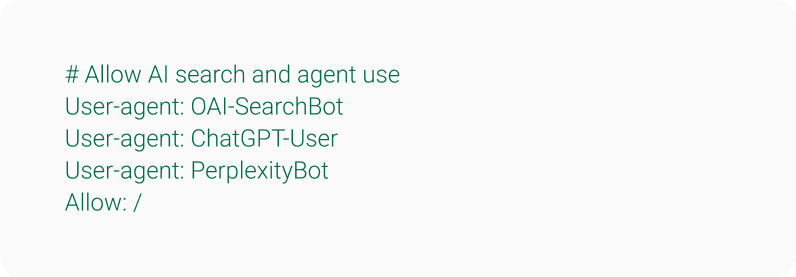
The first step is to make sure your site explicitly allows AI crawlers. Check your robots.txt file and ensure relevant bots aren’t being blocked, then test whether they can actually access your key pages using a tool such as Firecrawl.
You should also make your most important content easy to render and extract. Minimise unnecessary JavaScript dependencies, ensure critical information is available in readable HTML, and review firewall or bot-protection settings so legitimate AI crawlers aren’t being blocked by mistake.
Quick win: Check your robots.txt file and test a handful of your most important pages to make sure AI crawlers can access and read them properly. Start by updating your robots.txt file to grant explicit permission for AI crawlers. This takes only a few minutes but can significantly improve your visibility in AI search. Add the following lines:
2. What does ChatGPT look for in content it cites?
Content it can extract a clear, useful answer from. That means using descriptive headings, answering questions directly near the start of each section, and writing passages that still make sense when taken out of the wider page.
A clear structure makes that easier. Use a logical heading hierarchy to show what each section covers, and use lists, tables or bullet points where they genuinely make information easier to scan and understand. At the same time, each section should be focused enough to stand on its own while contributing to a more comprehensive answer overall.
That means covering the related questions and subtopics people are likely to ask, without turning every section into a long-form explanation of its own. Tools such as AnswerThePublic and AlsoAsked can help identify the language and questions people use around a topic.
The writing itself matters too. Clear, conversational language is easier for both people and AI systems to interpret, so avoid unnecessary jargon and write in a way that reflects how your audience would naturally ask or talk about the subject.
Quick win: Review your top-performing articles and move the clearest answer to the beginning of each section, with the relevant question reflected naturally in the heading or opening sentence.
3. Does schema markup help with ChatGPT citations?
Yes. Microsoft has confirmed that Bing uses schema markup to help its LLMs understand content, and ChatGPT Search is closely aligned with Bing. While ChatGPT hasn’t confirmed schema as a direct citation factor, structured data gives AI systems clearer information about what a page contains and how its different elements relate to one another.
The type of schema you use should reflect the content itself. Article schema can clarify the author, publication date and topic of editorial content, while FAQ and HowTo schema give more structure to questions, answers and step-by-step information. For commercial pages, Product and Review schema can provide additional context around things like pricing, availability and ratings, while LocalBusiness schema helps define important information such as locations, opening hours and contact details.
Think of schema as an additional layer of context. It won’t make weak content citation-worthy on its own, but it can make good content easier for search engines and AI systems to interpret accurately.
Quick win: Check that your most important pages are using the most relevant schema type, then validate the markup to make sure it’s being implemented correctly.
4. What kind of queries should I be targeting?
Focus on conversational, long-tail questions that reflect how people actually speak. Traditional SEO has often centred on shorter keyword phrases, but people interact with ChatGPT differently – asking complete questions, adding context and refining what they want through conversation.
That means targeting queries such as ‘how do I improve my website’s loading speed on mobile?’ rather than simply ‘mobile page speed’. Tools like AlsoAsked and AnswerThePublic can help uncover the questions and language people use around a topic, which you can then reflect naturally in your headings and content.
Informational and problem-solving queries are particularly important. Research shows that long-tail informational searches are more likely to trigger AI-generated responses, so questions beginning with ‘how’, ‘what’, ‘why’ and ‘what’s the best way to’ can create strong opportunities for visibility.
But the objective isn’t simply to make keywords longer. You still need to understand the intent behind the question and provide the clearest, most useful answer to what that person is actually trying to achieve.
Quick win: Take your priority short-tail keywords and identify the longer, conversational questions people are likely to ask around each one, then build or adapt content to answer them directly.
5. Does my Google ranking affect whether ChatGPT cites me?
Yes – significantly. Research has found a strong correlation between high Google rankings and mentions in AI-generated answers, with top-ten content far more likely to be referenced by large language models. Traditional SEO isn’t separate from AI visibility; it’s still the foundation.
That means the fundamentals continue to matter. Strong content, relevant backlinks, clear expertise signals, technical performance, and genuine alignment with search intent all contribute to the authority AI systems are likely to recognise. Keeping important pages current, well-structured and genuinely useful remains just as important as it is for traditional search.
The data backs this up. Research from SE Ranking across 129,000 domains found that the number of referring domains was the strongest predictor of ChatGPT citation likelihood. Sites with more than 350,000 referring domains averaged 8.4 citations, compared with 1.6–1.8 for sites with fewer than 2,500. Domain traffic was the second-strongest factor, although the correlation became more pronounced at higher traffic levels.
The takeaway is simple: you shouldn’t abandon traditional SEO in pursuit of AI visibility. The stronger your authority and performance in search already are, the better positioned you are to be surfaced by ChatGPT too.
Quick win: Audit your strongest-performing pages and reinforce the signals that demonstrate authority – current statistics, original research, expert authorship and relevant backlinks.
6. How do brand mentions help ChatGPT visibility?
Brand mentions matter because ChatGPT doesn’t need to link to your website to surface your business. Research from BrightEdge found that ChatGPT mentions brands 3.2 times more often than it provides clickable citations, making recognition across the wider web an important part of AI visibility.
When the same brand is consistently associated with a topic across credible third-party sources, AI systems have more evidence to understand what that brand does and where it is relevant. That means visibility isn’t built solely through your own website. Discussion platforms, review sites, industry publications, and comparison content can all strengthen the signals surrounding your brand.
The data supports this. SE Ranking found that domains with a significant presence on Quora and Reddit received considerably more ChatGPT citations than those with little or no presence. A similar pattern appeared across review platforms such as Trustpilot, G2 and Capterra, where brands featured across multiple sites earned more citations on average.
Industry publications, roundups, and comparison sites matter for the same reason. Being consistently referenced alongside a particular product, service or area of expertise gives AI systems additional context about where your brand belongs. For certain searches, aggregator sites such as TripAdvisor, OpenTable and PCMag can become particularly influential because ChatGPT frequently draws on them when making recommendations.
The goal, then, isn’t simply to generate as many mentions as possible. It’s to build consistent, credible associations between your brand and the topics you want to be known for across the sources your audience – and AI systems – are likely to trust.
Quick win: Search for the publications, review platforms, forums, and comparison sites that consistently appear around your priority topics, then identify where your competitors are being mentioned and you aren’t.
7. How can YouTube help my ChatGPT visibility?
YouTube is one of the most important external sources for AI search. It is heavily cited by ChatGPT and other AI platforms, while also accounting for a significant share of citations within Google AI Overviews. That makes video another route to AI visibility, even when the content isn’t hosted directly on your own website.
Part of the reason is that YouTube gives AI systems a rich combination of information to work with. Video transcripts provide detailed, conversational text, while the video itself can demonstrate processes, products, and ideas that are harder to communicate through written content alone. This makes tutorials, explainers, demonstrations, reviews, and expert commentary particularly useful formats.
The same principles that apply to written content apply here too: answer real questions and cover topics with enough depth to be useful. Rather than publishing isolated videos, build groups or series around the subjects you want to be associated with. Walkthroughs, product demonstrations, expert interviews, and detailed commentary can all reinforce that topical authority.
How you describe the video matters as well. Titles should reflect the questions people actually ask, while descriptions should clearly explain who the video is for, what it answers, and what it covers. Accurate transcripts and captions give AI systems even more structured text to interpret and can strengthen the connection between your brand and the topic being discussed.
You can reinforce those signals further by embedding relevant videos within your website, adding useful context around them, and implementing VideoObject schema. This helps connect the video, the surrounding page, and the topic itself, giving search engines and AI systems a clearer picture of what the content is about.
The important point is that YouTube shouldn’t sit separately from your wider search strategy. Used well, it becomes another source through which your expertise, brand, and content can be discovered, understood, and cited.
Quick win: Identify the questions your audience asks most frequently and turn your strongest answers into well-structured YouTube videos, with clear titles, descriptions, accurate transcripts, and relevant embeds on your website.
How can I track my ChatGPT visibility?
Tools like Peec AI, Scrunch and ProFound give you the ability to track how frequently your site appears in ChatGPT responses in real time. These platforms show you which queries you’re being mentioned in, how often you’re cited, and whether the sentiment is positive or negative. You can’t improve what you don’t measure.
Key metrics to monitor:
Track how often your brand appears in ChatGPT responses (mention frequency) and how frequently you receive clickable citations versus mentions (citation rate). Monitor your citation percentage versus competitors (share of voice) to understand your competitive position.
Check whether mentions are accurate and positioned positively (context quality) and measure whether visitors from AI sources convert effectively (traffic quality). These metrics together give you a complete picture of your AI visibility performance.
While ChatGPT may currently drive less search traffic than platforms like Google or even Bing, its influence is growing fast. Businesses that start optimising now will be well-positioned to secure long-term visibility as the search landscape continues to evolve.
Final thoughts.
ChatGPT is changing how people discover content online. If you want to be part of the answers – not just another link – now is the time to optimise your site for AI-driven visibility. By following these seven strategies, you’ll boost your chances of being mentioned, referenced, and trusted by one of the most powerful language models in use today.
The essentials are:
- Make your site technically accessible to AI crawlers.
- Structure content clearly with headers and direct answers at the start of each section.
- Implement schema markup to help AI understand your content.
- Target long-tail conversational keywords that match how people actually speak.
- Maintain strong traditional SEO fundamentals.
- Build brand mentions across discussion platforms, review sites, and industry publications.
- Build a YouTube presence and optimise it for extraction.
The shift from traditional search to AI-powered discovery is already underway. Brands that adapt their strategies now will own visibility in the next era of search.