
“AI Mode doesn't rank your page. It decides whether your brand is worth mentioning.”
More from FrancescaWhat is Google AI Mode?
What Google AI Mode is, how it works, and why being cited now matters more than being ranked.

Introduction.
Search is constantly evolving. We’ve seen it shift from desktop to mobile, then adapt to voice search, social search, and AI tools like ChatGPT. But Google’s AI Mode represents a much bigger leap and may soon become the default experience for the world’s most-used search engine.
This new approach won’t just change SEO, it promises to fundamentally rewrite the rules of the game, and render the traditional practice of optimising web pages to rank for specific keywords obsolete. Instead of competing for top spot on a search results page, brands now also need to fight to be referenced in AI-generated answers. And those AI generated answers may never direct users to the brand’s website, either.
This looks daunting – but the businesses who get ahead of it now have the advantage. Here’s what Google AI Mode actually is, how it differs from AI Overviews and Gemini, how it works, and what it means for you.
How AI Mode changes the search experience.
Google AI Mode is an AI assistant that answers your questions by pulling information from across the web. It holds context, remembers what you’ve asked before, and gives you direct answers instead of a list of links.
You’ll meet it in two places. In Google Search, where a follow-up question takes you from an AI Overview into a conversation. And in the Google app, where the interaction is conversational from the start.
That’s a departure from the search experience we’ve all used for two decades. Rather than scanning a page of blue links, you’re holding a dialogue – asking follow-ups, clarifying an ambiguous request, getting suggestions shaped by your search history and personal data. The aim is to handle the nuanced, multi-part questions that used to mean opening six tabs and piecing the answer together yourself. Classic results haven’t gone. Google has been clear the new experience doesn’t mean AI answers only. They’re just no longer the whole page.
Google claims that AI mode: “expands what AI Overviews can do with more advanced reasoning, thinking and multimodal capabilities – so you can get help with even your toughest questions. You can ask anything on your mind and get a helpful AI-powered response with the ability to go further with follow-up questions and helpful web links.”
Why it matters.
Google AI Mode has huge implications for how we will find and consume information going forward. For many queries there may be no need to visit external websites at all – and this is a massive concern for businesses who rely on organic search traffic for their leads, sales or brand awareness. AI Overviews now reach over 2.5 billion users per month, and have already been shown to lower click-through rates by around 30%. AI Mode’s fully conversational interface is likely to reduce clicks even further. But all is not lost, when AI traffic is arriving, it’s converting at a 4.4x higher rate than traditional search traffic.
Why Google built AI Mode.
AI Mode is Google’s answer to a real competitive threat. ChatGPT gave people a reason to start their search somewhere other than Google for the first time in two decades.
Google still owns conventional search with 91.1% of the global market. The AI assistant market told a different story. A year ago Gemini held under 2% of it. It now holds around 28%, and ChatGPT has slipped below half for the first time since launch. The Gemini app passed 900 million monthly users at I/O 2026, more than double the year before.
What is the difference between AI Mode and AI Overviews?
The gap between AI Mode and AI Overviews is less than there used to be. At I/O on 19 May 2026, Google merged the two into one seamless AI Search experience, live globally on desktop and mobile from launch day. They’re no longer separate products you choose between. They’re one experience at two depths.
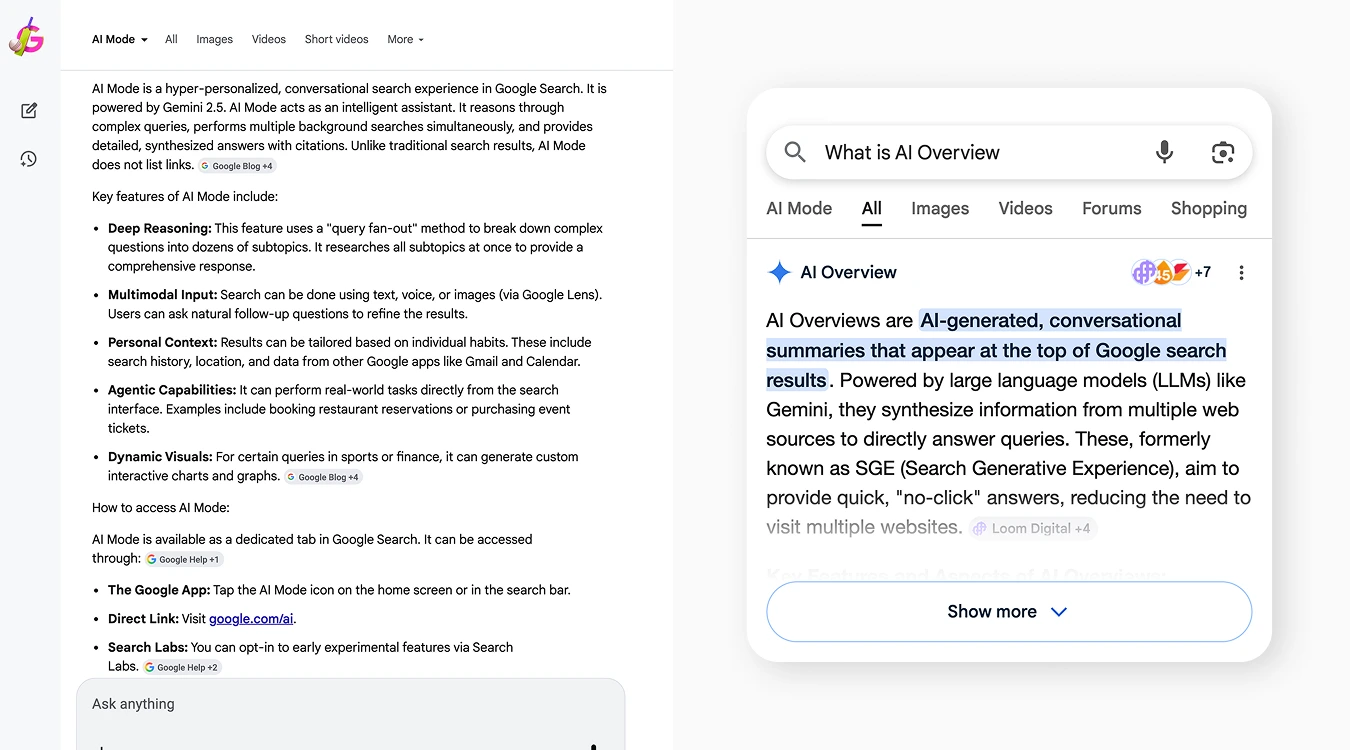
Here’s how that works in practice. You ask a question and get an AI Overview on the results page – a summary with the familiar blue links beneath it. If the answer is enough, you stop there. If it isn’t, you ask a follow-up and flow directly into a conversational back-and-forth in AI Mode, with the context of your original question carrying across the whole session.
AI Overviews is the shallow end. Blue links stay, the classic results page stays, and most people never go further. AI Mode is the deep end. Conversation becomes the primary format, links move to a supporting role, and the session holds context across multiple exchanges.
| AI Overviews | AI Mode | |
|---|---|---|
| Where it appears | Above traditional results on the search results page | A conversational experience you flow into from an Overview |
| Traditional blue links | Retained beneath the summary | Not the primary format, links provided as supporting sources |
| Advertisements | Yes | Yes |
| Citations | Yes | Yes |
| Conversational follow-ups | Yes, hands off into AI Mode | Yes, native and context-carrying |
| Monthly users | 2.5 billion | Over 1 billion |
| Search Console reporting | Generative AI reports, impressions only | Generative AI reports, impressions only |
What is the difference between AI Mode and Gemini?
This is a question that confuses many people, as both are Google AI products with overlapping capabilities. The key difference is in their purpose and where they live.
Gemini is Google’s standalone AI chatbot – similar to ChatGPT or Claude. You access it through gemini.google.com or the Gemini mobile app. It’s a general-purpose AI assistant for tasks like writing, coding, analysis, and creative work. Think of it as Google’s competitor to ChatGPT.
AI Mode is built directly into Google Search. You don’t need to visit a separate website or app. Whilst AI Mode is powered by the same Gemini 3.5 Flash technology, it’s specifically designed for search tasks and has direct integration with Google’s search index, allowing it to access real-time web content.
| AI Mode | Gemini | |
|---|---|---|
| Location | Within Google Search | Separate app/website (gemini.google.com) |
| Primary purpose | Search and discovery | General-purpose AI assistance |
| Access to live web data | Yes, native to the search experience | Yes, via grounding with Google Search |
| How it reaches the web | Direct integration with Google’s search index | Calls Google Search as a tool when the model judges it necessary |
| Conversational memory | Session-based | Persistent across sessions |
| Personal data | Personal Intelligence, opt-in connection to Gmail and other Google apps | Connected Google services including Gmail, Drive, Docs, Maps and YouTube |
| Model | Gemini 3.5 Flash (default) | Gemini 3.5 Flash (default) |
In practice: You might use Gemini to draft a business proposal or analyse a spreadsheet, but you’d use AI Mode within Google Search when you want to research “best electric cars under £40,000” and have a conversation about specs, reviews, and availability.
Both are powered by Google’s Gemini technology, but they’re optimised for different use cases. For most search-related tasks, AI Mode is the more natural choice because it’s integrated where people already search – Google.com.
How is AI Mode powered?
AI Mode runs on Gemini 3.5 Flash, which Google made the global default at I/O in May 2026, replacing a custom version of Gemini 2.5.
Flash models are built for frontier-level intelligence at speed, which is what a real-time conversational search experience needs. Three mechanics matter for anyone trying to be found in it.
Query fan-out.
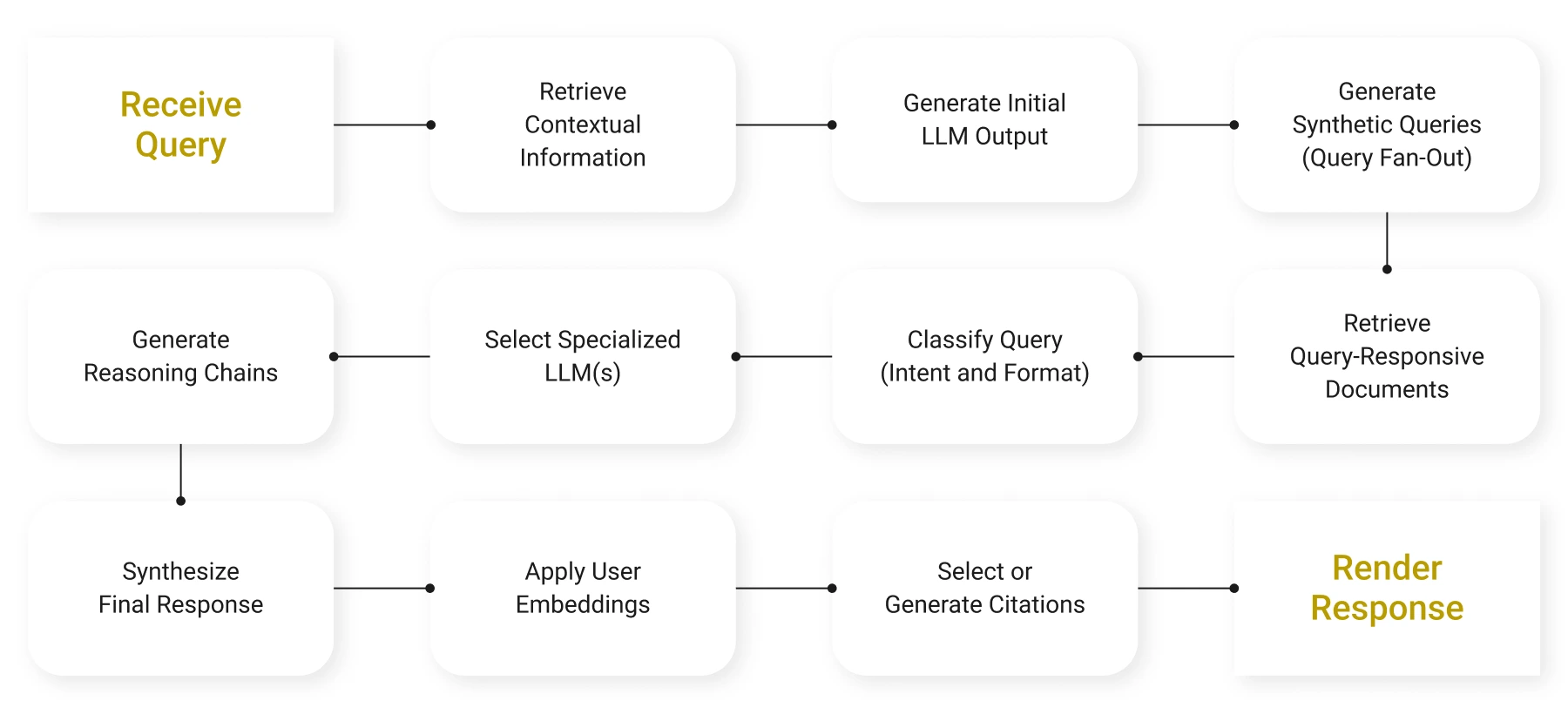
AI Mode doesn’t search for the phrase you typed. It breaks your question into subtopics and runs multiple searches at once. Ask about the best electric car and it will also consider reliability, price and range – answering what you probably meant, not just what you said.
Behind that, specialised systems handle different jobs. One compares, one summarises, one filters against your budget and history, and another synthesises the lot into a single answer.
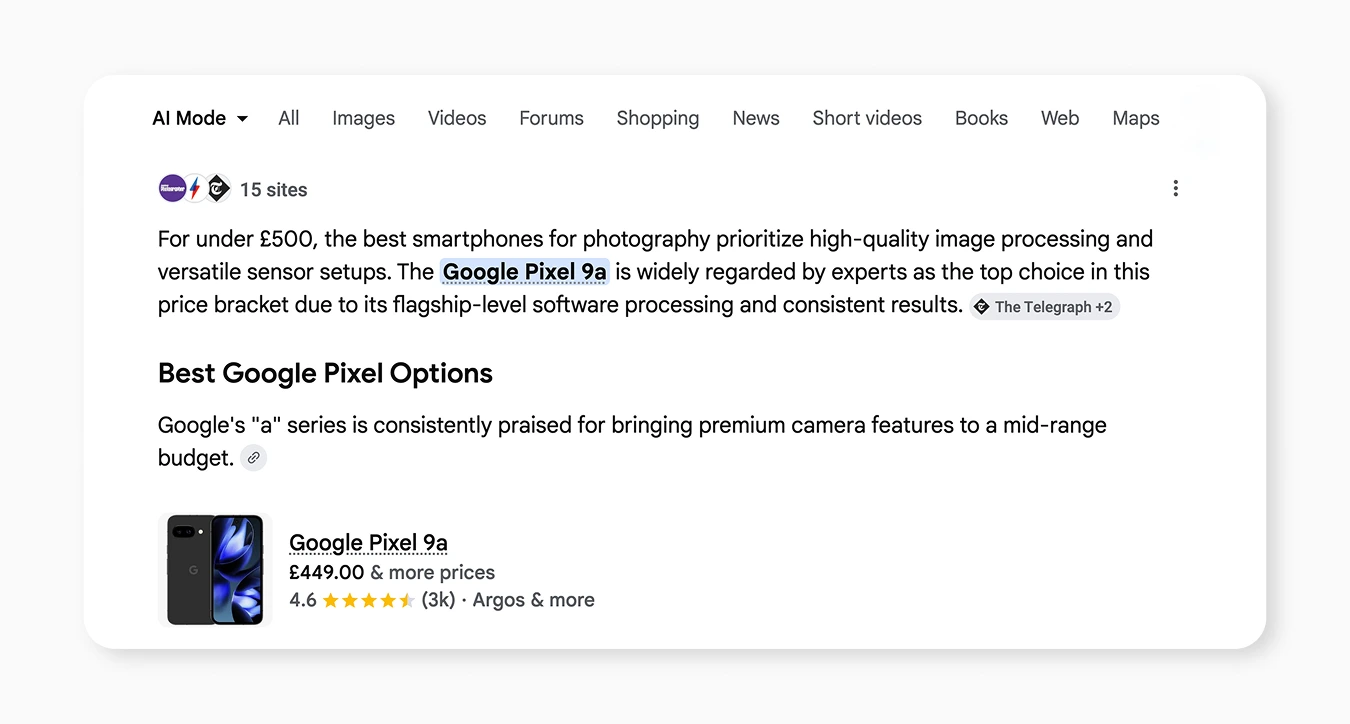
Search “best smartphones for photography under £500” and it looks something like this:
- Comparison AI analyses camera specs across different phone models and ranks them by photo quality.
- Summarisation AI condenses hundreds of photography reviews into key strengths and weaknesses.
- Recommendation AI filters results based on your £500 budget and previous searches for camera equipment.
- Synthesis AI combines all this information into a single response: “Based on your photography interests and budget, here are the top 3 camera phones under £500, with the iPhone SE recommended for portrait mode and the Google Pixel 7a for low-light photography…”
Multimodal understanding.
AI Mode pulls from text, video, audio transcripts and images, then remixes them. A video supplies a quote, a podcast supplies a data point, an infographic becomes part of a written answer. YouTube is currently the single most cited domain for Gemini, which tells you how much weight video carries.
Personalisation.
AI Mode builds a picture of your interests from your Google activity, so you and a colleague can ask the same question and get different answers. There is no single result to rank for.
Together these break the old model. Ranking for a keyword on your website is no longer enough. Your content needs to be findable and citable across formats and contexts – blog posts, video, podcasts, social. Wherever your brand shows up.
UK launch and adoption.
Google officially launched AI Mode in the UK on July 28, 2025, making it the third market to receive the feature after the United States and India. The UK rollout skipped the Search Labs experimental phase entirely, rolling out directly to all users.
Since May 2026, AI Mode has been expanded to 200 countries and 98 languages via Personal Intelligence, no subscription needed, which has significantly boosted adoption numbers.
Adoption statistics.
The adoption numbers show significant user interest:
- Over 1 billion monthly users globally have already accessed AI Mode (as of May 2026).
- Sessions are 38% longer in AI Mode compared to traditional search.
- Queries are 2-3x longer than traditional search queries.
What this means for UK businesses.
For UK businesses, the AI Mode launch brings both opportunities and challenges:
- Traffic concerns – Zero-click searches are likely to rise significantly. Because AI Mode answers queries directly within the interface, many users won’t need to click through to websites. Early US data suggests traffic drops of up to 25% for some publishers.
- Multimodal optimisation - Content must now be optimised across text, images, and video. Sites that rely solely on text-based SEO may find themselves excluded from AI Mode citations.
- Measurement challenges – Measurement is improving, but still partial. Search Console now carries generative AI reports, though they remain impression-only, so you can see that you appeared without knowing what it drove.
The message is clear: UK businesses need to start adapting their SEO strategies now, not waiting to see how AI Mode performs. The competitive advantage will go to those who optimise early.
Final thoughts.
Google AI Mode represents the most significant transformation in search since Google’s inception — a complete paradigm shift that fundamentally changes how people find information online and how businesses get discovered.
The shift to AI Mode is inevitable, but it’s not insurmountable. Businesses that understand these changes and begin adapting now will maintain their competitive advantage. Those who cling to outdated SEO practices risk being left behind entirely.
If you would like to learn how your business can most effectively navigate this new landscape, we go into detail on the subject in our companion blog, “What does Google AI Mode mean for SEO strategies?”