Google Marketing Live 2026: Everything that actually matters.

Google Marketing Live happened on 20 May 2026, and if you work in marketing, there was a lot to take in. The two-hour keynote – livestreamed to over 100 countries – was built around one central message: Gemini is no longer just a feature inside Google Ads. It is becoming the infrastructure. Search, creative, commerce and measurement are all being rebuilt around it.

This piece covers the announcements that matter and what they mean for advertisers. We’re not recapping the keynote for the sake of it. If it’s in here, it’s worth knowing about.


A New Generation of AI Search Ads.

Google’s built new ad formats for AI Mode – the conversational search experience now used by over a billion people monthly. They’re purpose-built to exist inside a conversation, not alongside it. Google’s official post on the new Search ad formats covers the full detail.

The new formats include:

  • Conversational Discovery Ads – read as part of the AI response, not beside it.
  • Highlighted Answers – AI-generated explainers embedded in Search results with ad placement.
  • AI-powered Shopping Ads – Gemini writes product summaries tailored to each query.
  • Business Agent for Leads – prospects ask questions inside the ad, answers pulled from your website. Live in automotive, education, real estate. [Search Engine Journal]
  • Direct Offers – exclusive discounts at purchase intent, with native checkout built in.

What you need to know.

To appear in AI Search experiences, you must use AI Max for Search or Performance Max with text customisation enabled. Google’s VP of Ads and Commerce was direct: “You can’t choose keywords anymore.”

This matters. Dynamic Search Ads will automatically migrate to AI Max in September 2026. That is not a recommendation – it is a deadline.

We’ve also published a more detailed breakdown of what these updates mean specifically for Google Ads campaign management.


Lufthansa Group: 24% increase in ROAS with AI Max. IKEA: 65% lift in non-branded clicks and 28% boost in incremental ROAS. Advertisers on AI Max or PMax see 15% more conversions at a similar ROAS.

Brainlabs source


AI Brief: Brand Control Inside AI Max.

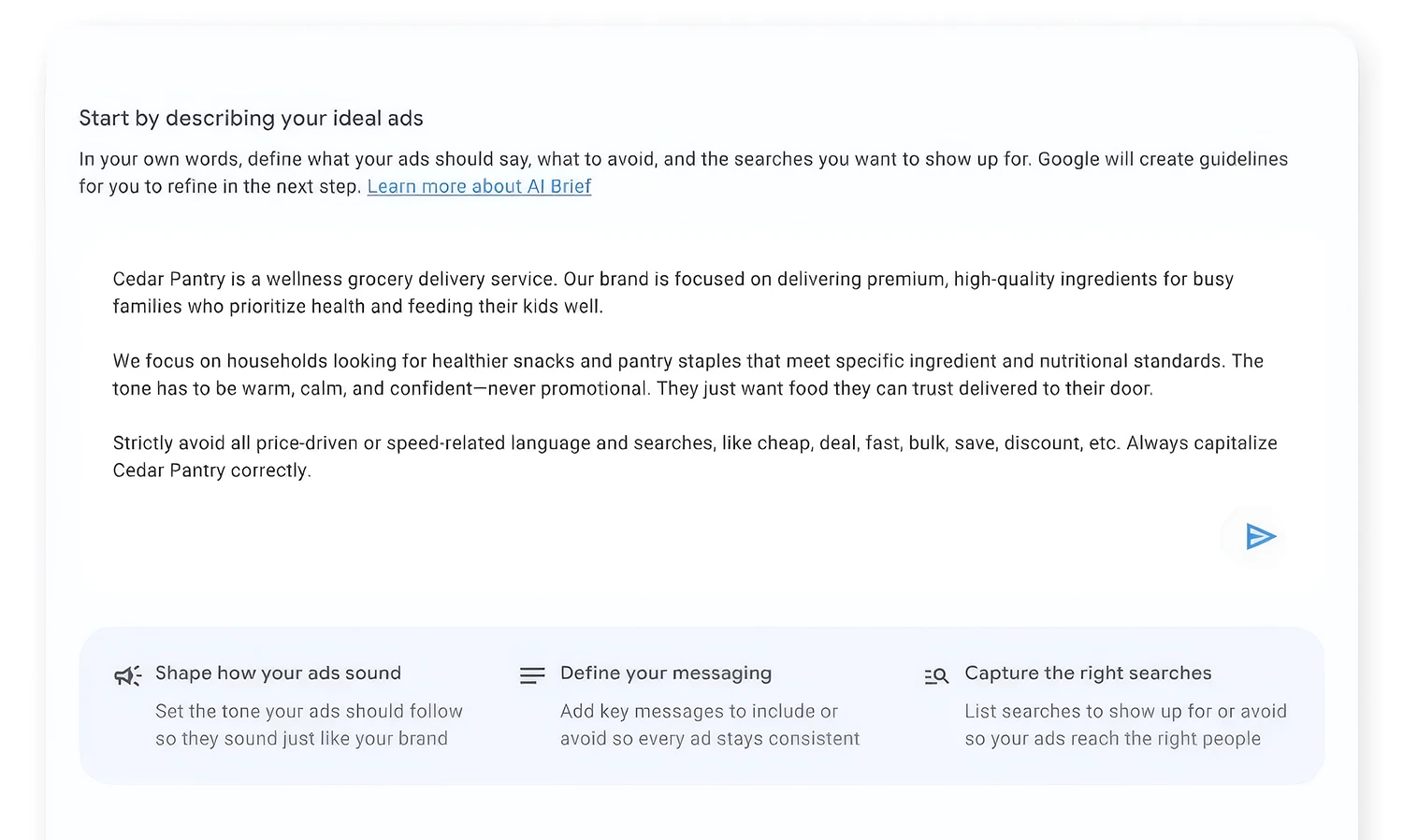
AI Brief is the new way to steer AI Max and Performance Max campaigns using natural language. Rather than adjusting toggles, advertisers write a description of their brand – what to say, what to avoid, which audiences to prioritise – and Google uses that context to generate ad guidelines and asset previews. Google’s full overview of AI Brief explains the three control layers:

  • Messaging Guidelines – tell AI exactly what your ads should and should not say.
  • Matching Guidelines – define which searches to capture or avoid.
  • Audience Guidelines – specify who to target and how messaging should adapt for them.

The significance goes beyond creative control. For the first time, advertisers can run A/B tests not just between ad copy variations, but between different brand propositions. Brainlabs describes it as “the top dog of this year’s new product releases” – and it is hard to argue. Brief writing is becoming a genuine strategic skill for paid search teams, and the quality of your inputs will directly shape performance.

AI Brief rolls out in English for AI Max for Search first, followed by Performance Max and AI Max for Shopping.

AI Brief screenshot


Ask Advisor: One Agent Across the Entire Google Ecosystem.

Google is consolidating its separate in-product AI assistants into a single conversational agent called Ask Advisor. It spans Google Ads, Google Analytics, Google Marketing Platform and Merchant Center, with a shared memory layer that retains your goals as you move between tools.

In practice, this means you can ask a single question – “find new customers for my hair care products” – and Ask Advisor will pull product data from Merchant Center, build a campaign in Google Ads, and surface performance insights from Analytics – without switching platforms.

Ask Advisor is currently in beta for English-language accounts. PPC Land’s coverage of the Ask Advisor launch notes it absorbs Ads Advisor, Analytics Advisor and the forthcoming Merchant Center agent into one continuous interface – the most direct response yet to how marketers actually work today


Asset Studio Gets Gemini Omni and 1-Click Creative Testing.

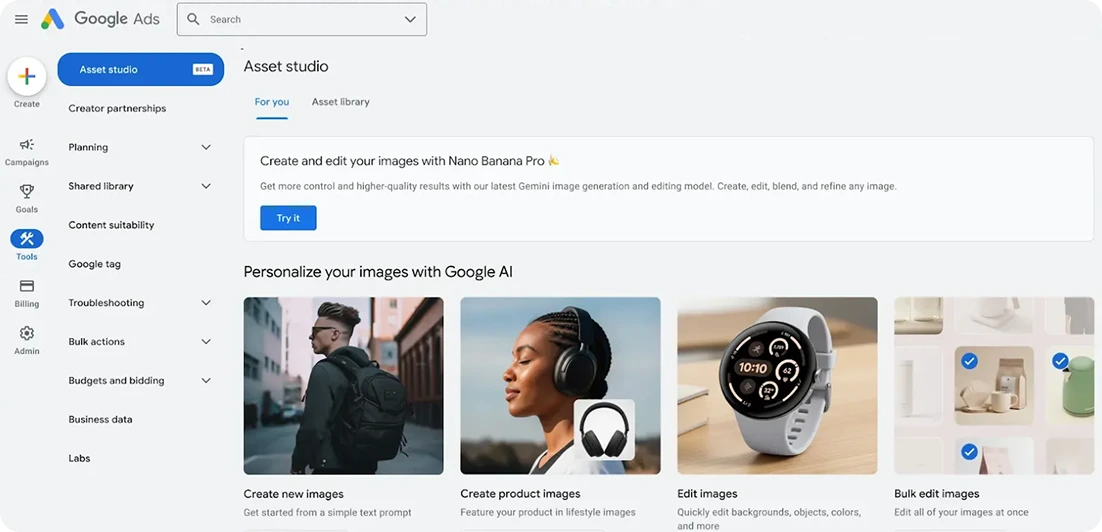
Asset Studio – Google’s unified creative workspace inside Google Ads – was upgraded with multimodal capabilities powered by Gemini, Veo and Gemini Omni (rolling out globally in English this summer). Advertisers can generate images, video assets, text variations and full creative themes from a natural language prompt, pulling in existing brand materials to stay on-brand.

The standout addition is 1-Click Creative Testing, which automatically runs new assets against current top performers. Brainlabs note that creative testing has historically been underused – most advertisers either skip it or run tests too loosely to get reliable results. If this genuinely makes structured testing easy, it changes how creative strategy operates within paid campaigns.

Asset Studio can also pull assets from external tools including Adobe and Canva, and Google has opened the capability via API.


Google asset studio


Google cited that creative drives nearly half of all incremental ad sales – the rationale for the Asset Studio investment.

PPC Land source


Demand Gen: YouTube Performance, Google Maps and Better Attribution.

Google made the case, again, that YouTube should be treated as a performance channel rather than a reach channel. The supporting figures: 45% of YouTube Shorts viewers are not on TikTok, and 65% are not on Reels. Advertisers who add Demand Gen to a mix of Search and Performance Max see a 10% higher ROAS and 12% higher sales.

The product updates include:


Only 40% of Demand Gen conversions happen in the first 30 days. Advertisers with large product feeds see a 33% increase in conversions when adopting product feeds in Demand Gen campaigns.

PPC Land sourceGoogle source


AI Max for Shopping: Capture the Queries Your Feed Can't Match.

Standard Shopping campaigns match ads to queries by reading product feed attributes: titles, descriptions, categories. They miss the increasingly common conversational searches – “What are the best high-quality clothes for lounging?” – because no feed attribute directly matches them. AI Max for Shopping is a one-click toggle that removes that constraint.

It uses your Merchant Center feed to generate dynamic ad copy, match the most relevant landing page via Final URL Expansion, and automatically select the best format per query. Existing product targeting and bidding controls remain intact, and Final URL Expansion can be turned off at any time. For most advertisers on standard Shopping campaigns, this should be on the implementation list.

The open question is where this leaves Performance Max, which is also designed to capture long-tail and conversational Shopping queries. Brainlabs flag this directly: Google has not provided a clear framework for when to use which. That is worth watching.


Universal Cart and UCP: Google Becomes the Checkout Layer.

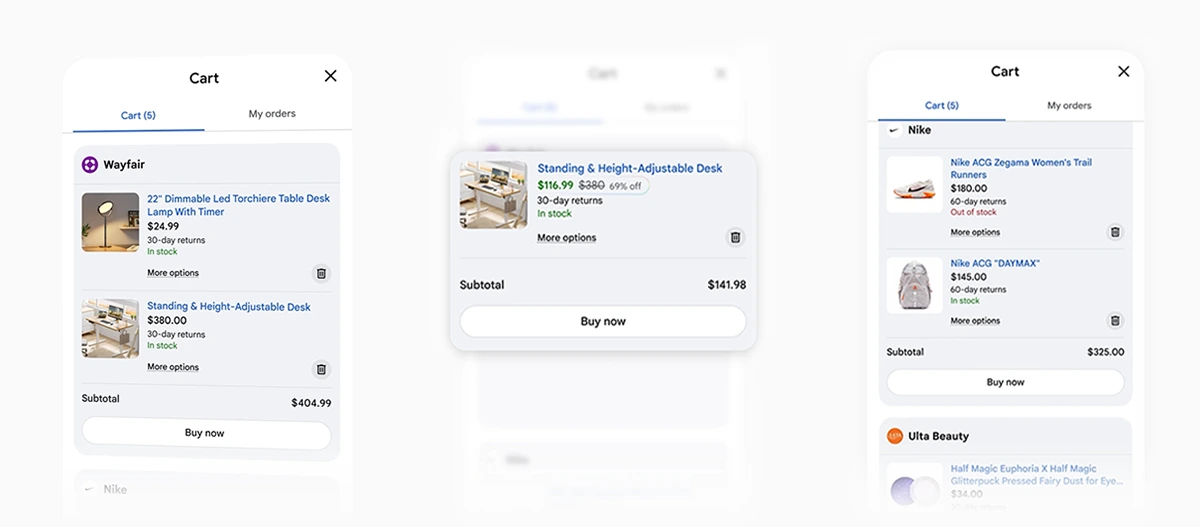
The Universal Commerce Protocol (UCP) – Google’s open commerce standard co-developed with Shopify, Etsy, Wayfair, Target, Walmart, Amazon, Meta, Microsoft and others – is expanding significantly. The headline consumer launch is the Universal Cart: a single, persistent shopping cart across Search, YouTube, Gmail and Gemini that tracks price changes and back-in-stock alerts.

The Universal Cart began rolling out in the US on 19 May 2026. UK availability is planned in the coming months.

For advertisers, the UCP enables:

  • Native checkout inside Direct Offers – a ‘buy with one-time code’ button completing via Google Pay. [Google Blog]
  • Buy-now-pay-later integrations with Klarna and Affirm, embedded into Google Pay.
  • UCP-powered checkout within Shopping ads on YouTube via Demand Gen campaigns.

Expansion into food delivery and hotel booking – users will be able to order food or book hotels directly from AI Mode in Search or a Google Maps conversation.

The Shopping Graph that underpins this now holds over 60 billion listings. Google is moving from being the discovery layer of online shopping to being the transactional layer.


Universal shopping cart


Measurement: Meridian Moves Into Analytics 360 and QFCs Change the Attribution Conversation.

The measurement announcements were the least headline-grabbing at GML, but arguably the most structurally significant.

Meridian – Google’s open-source Marketing Mix Model – is being integrated directly into a reimagined Google Analytics 360. This moves MMM from a specialist data-science workstream into a standard component of an enterprise analytics platform. Advertisers can analyse performance across Google, TikTok, Pinterest and Snap in one place, and run scenario planning through a natural-language agentic interface.

Alongside this, Google introduced two new causality signals:

  • Attributed Branded Searches – tracks short-term intent created by an ad, available now in Google Ads and GMP.
  • Qualified Future Conversions (QFCs) – a Gemini-powered metric that predicts conversions up to six months ahead, using follow-up branded searches and engaged site visits as early intent signals. No custom tagging required. [Brainlabs]

QFCs are a direct challenge to 30-day attribution windows. The practical example Google used: UK retailer Crew Clothing ran a YouTube prospecting campaign that looked flat over 30 days, but through QFCs revealed a 70% uplift in long-term conversions. Doc Martens saw a 16% revenue jump after feeding first-party data into Performance Max.

This changes how advertisers report to finance teams and how upper-funnel investment gets justified.


Smarter Data: Google Tag Gateway, Product Value Adjustments and Data Manager.

Several announcements at GML addressed the same underlying problem: the signals going into Google’s automated systems are often incomplete, misaligned with business goals, or technically leaky. Three tools are Google’s answer to that.

Google Tag Gateway (GTG).

Routes conversion tag signals through your own domain’s server rather than Google’s infrastructure. The result is better data accuracy, higher match rates and first-party data more resilient to browser-level tracking restrictions – with no changes to existing tag code.  GTG provides 11% more signals through Confidential Matching for advertisers using customer match – a direct performance unlock.

Product Value Adjustments (PVAs).

Allows ecommerce advertisers to apply conversion value multipliers to specific SKUs directly within Merchant Center or Google Ads – without touching campaign structure. Brainlabs outline the practical applications: upweighting high-repeat-purchase products, deprioritising high-return SKUs, or accelerating sales of overstocked inventory.

Data Manager API Updates.

Google’s centralised hub for connecting first-party data now has direct connectors to Mailchimp, ActiveCampaign and Klaviyo. This is a real improvement for mid-market advertisers, where getting CRM data flowing reliably into Google’s systems has been a persistent barrier.

 

Why We Care.

GML 2026 was not a collection of independent product launches. As PPC Land put it, the announcements were “less a set of isolated launches than a consolidation of a year of incremental changes into one coherent system.” Google is confirming the direction it has been moving in and formalising it.

The practical implications are real and immediate:

  • The DSA-to-AI Max migration is mandatory by September 2026. Accounts that depend on granular keyword control need a plan now.
  • AI Brief changes what good brief-writing looks like for paid search practitioners. The quality of your brand inputs will directly shape ad performance – that is a new skill set.
  • QFCs and Meridian in GA360 shift the reporting conversation from 30-day attribution to long-term predictive signals. If you manage stakeholders who live and die by last-click ROAS, this changes the conversation you need to have with them.
  • Universal Cart means more of the purchase journey will happen inside Google’s ecosystem. For retailers, that is both an opportunity and a structural shift in where conversion data lives.
  • Ask Advisor, if it functions as described, removes significant operational friction across campaign management. It will not replace strategic thinking – but it will accelerate execution.

The direction is clear: Google is asking advertisers to move control upstream – from manual execution toward goals, inputs and guardrails – while Gemini handles the matching, generation and optimisation. The teams that adapt to that model fastest will have a structural advantage.


The Bottom Line.

GML 2026 landed a year’s worth of product changes in a single keynote. The announcements span Search ad formats, creative production, commerce infrastructure, attribution and campaign management – and they share a single direction. Google is restructuring how advertising works around AI, and the pace of that shift is accelerating.

The mandatory DSA migration in September is the most pressing near-term action. But the bigger picture is strategic: understanding what it means to write an effective AI Brief, report on Qualified Future Conversions, or position a brand inside Universal Cart – these are the skills that will define performance in the next 12 to 24 months.

Francesca Hume
LinkedIn

Francesca Hume

Francesca makes brands easier to find and harder to ignore. She keeps search and paid channels tuned to client goals, turning visibility into pipeline and pipeline into revenue.