
“Google keeps taking over the execution layer. The advertiser's job is getting more strategic, not less.”
More from FrancescaGoogle Marketing Live 2026: What it means for your Google Ads campaigns.
What Google’s latest announcements change about how campaigns are run – and which of them are actually worth acting on now.

Introduction.
Every year, Google Marketing Live (GML) brings a wave of announcements. And every year, the internet responds with articles covering all of them. This isn’t one of those articles.
GML 2026 was significant – not because Google launched dozens of new products, but because the direction of travel became much clearer. Search is increasingly conversational, AI is handling more of the execution layer, and several new tools give advertisers much better ways to guide that AI – rather than just hand it the keys.
What follows is a breakdown of the changes most relevant to how Google Ads campaigns are run – and an honest view of what’s worth acting on, what’s worth watching, and what can wait.
If you want the wider picture beyond Google Ads specifically, we also covered all the major announcements from Google Marketing Live 2026 in one place.
New ad formats built for AI Mode.
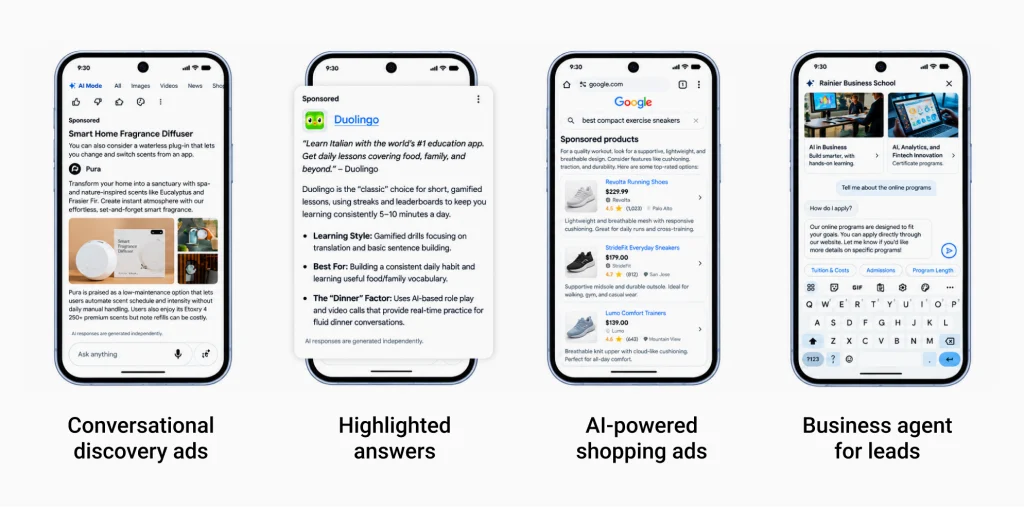
Google unveiled four new ad formats built specifically for AI Mode. These are worth knowing about, even if they’re not immediately relevant to every account.
- Conversational Discovery Ads – appear within AI Mode responses, woven into the AI’s answer rather than placed alongside it.
- Highlighted Answers – placed within AI-generated recommendation lists at the point a user is being guided towards a decision.
- AI-powered Shopping ads – Gemini writes dynamic product summaries tailored to each query, not static ads.
- Business Agent for Leads – lets prospects ask questions directly inside the ad, pulling answers from your website. In open beta for US advertisers, starting with automotive, education and real estate.
As of September 2026, all four are still US-only (as they were when announced in May) and at different stages. Conversational Discovery ads and Highlighted Answers are still in testing, with no confirmed general rollout date or geographic scope – and several months on, few advertisers report seeing them live. AI-powered Shopping ads are expected in the US later this year. Business Agent for Leads is furthest along, in open beta.
To run any of them, advertisers need to be on AI Max or Performance Max with text customisation enabled. For UK accounts, none of this is actionable yet. Google has no published international timeline. But the direction is worth understanding, because the formats change what you optimise: Gemini assembles the creative per query, so structured product data, asset diversity and landing page quality do the work that pre-built creative used to.
AI Max updates.
AI Max matches intent, not keywords. That means it captures long-tail, conversational queries that standard keyword campaigns miss – because those queries don’t contain the exact terms you’ve bid on.
AI Max was initially introduced in 2025, and is now generally available and out of beta. Google reports strong performance figures from early adopters. As with all figures cited directly by Google, treat these as directional rather than guaranteed benchmarks for your own account:
- 27% more conversions vs standard campaigns.
- Lufthansa Group reported a 24% increase in ROAS after adopting AI Max.
- IKEA saw a 65% lift in non-branded clicks and 28% increase in incremental ROAS.
- Across AI Max and PMax advertisers broadly: 15% more conversions at a similar ROAS.
As AI Max turned 1 in May 2026, it was unveiled at this year’s Google Marketing Live that it has also expanded to Shopping campaigns as a one-click toggle, and is coming to Travel. For Shopping specifically, it allows campaigns to respond to natural language queries that standard feed-matching would miss – a shopper asking ‘what are the best high-quality clothes for lounging?’ rather than searching for a specific product name.
When to test it:
Our original advice was that you needed 50+ conversions monthly and four weeks of clean baseline data before making any change – without it, you couldn’t tell if AI Max was driving real gains or just reshuffling existing traffic. The framing’s shifted since GML in May: AI Max moved out of beta in June and is now the default on new Search campaigns, so the real question isn’t whether to adopt it, but how much control you keep.
The honest take:
AI Max is a strong option for accounts looking for incremental reach beyond what keyword matching captures. For campaigns already working well, the priority is configuring the controls rather than chasing the reach.
AI Brief: giving the AI a proper brand brief.
AI Brief landed shortly before GML, and it’s the change with the broadest long-term implications.
The recurring concern with AI-driven campaigns has always been control – specifically, the worry that handing creative generation to AI means losing the brand guardrails that matter. AI Brief addresses this directly.
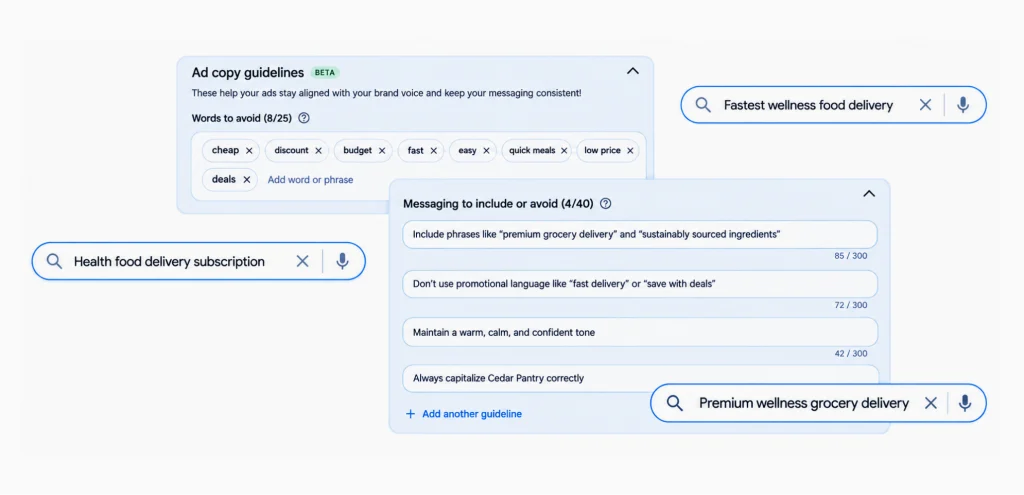
Instead of settings and toggles, you write a plain-language brief. Think of it as the brief you’d give a new copywriter: here’s our brand, here’s what we say, here’s what we don’t, here’s who we’re talking to. Gemini then uses that context to govern how your ads are generated. Full details on AI Brief are on Google’s Ads & Commerce blog.
Three inputs:
- Messaging Guidelines – what your ads should and shouldn’t say. e.g. ‘Always lead with free delivery.’ ‘Never mention competitor pricing.’ This is brand governance in plain language.
- Matching Guidelines – which searches to prioritise or avoid. e.g. ‘Target searches related to professional training, not hobbyist queries.’ These are intent-level targeting without keyword lists.
- Audience Guidelines – who to reach and how to speak to them. e.g. ‘For health-conscious shoppers, lead with clean ingredients.’ This is persona-led messaging built into the brief itself.
Before you commit, AI Brief shows asset previews and sample searches so you can iterate. If you already have text guidelines set up in your campaigns, they’ll migrate automatically into Messaging Guidelines when you adopt it.
AI Brief is rolling out in English for AI Max for Search campaigns in the coming months, then Performance Max and AI Max for Shopping. It doesn’t require any structural campaign changes to adopt – which makes it one of the lower-friction improvements from GML worth getting on the list. (Worth noting that as of 8th September 2026, there is still no fixed rollout calendar).
AI Brief is the first product that creates a direct relationship between how well you can articulate your brand and the performance you get from your campaigns. Brief writing is about to become a genuinely valuable skill in paid search.
Jack Kennedy, Founder, Invanity Marketing
DSA and AI Max migration.
Google originally confirmed that Dynamic Search Ads would be automatically upgraded to AI Max in September 2026. In June, after advertiser feedback about making major changes before Q4, it pushed that to February 2027 and restored the ability to create new DSA campaigns.
What is now happening (as of September 2026) affects far more accounts. Throughout September, Google is automatically upgrading Search campaigns that use campaign-level Broad Match or standalone Automatically Created Assets to AI Max.
DSA works by crawling your website and dynamically generating headlines and destination URLs based on page content. It’s been a reliable tool for capturing long-tail queries without manual keyword management – particularly useful for large catalogues or sites with frequently changing inventory.
AI Max replaces that crawl-based matching with intent-based, conversational matching. The reach is broader and the coverage of nuanced queries is better. But there are some real transition considerations worth knowing about.
Practitioners flagged on GML day itself that AI Max can sometimes route product queries to generic landing pages rather than the specific product page – the one thing DSA reliably handled well. Google’s Final URL Expansion is designed to address this and reached general availability in April 2026, but it’s still worth testing against your own key product queries rather than assuming.
The practical takeaway depends on your situation:
- If you run campaign-level Broad Match or Automatically Created Assets – the change is happening now. Check your search term controls, negative keywords and brand exclusions this month (September 2026) rather than after.
- If you run DSA campaigns – you have until February 2027. Use the window to run side-by-side experiments rather than waiting for the automatic migration, which also preserves your historical reporting and campaign learnings.
- Either way – review how Final URL Expansion routes your key product queries before you commit.
Two dates for the diary. September 2026 for Broad Match and Automatically Created Assets, which is happening now. February 2027 for DSA, when automatic migration begins and the ability to create new DSA ad groups disappears permanently. Google has moved the DSA date once already, so treat it as firm but not fixed.
Ask Advisor.
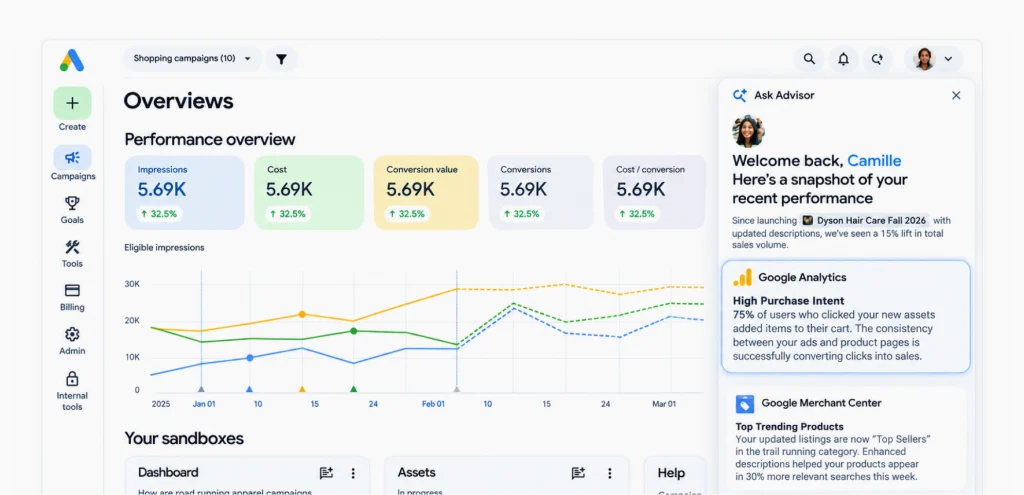
Ask Advisor was announced at GML as a unification of Google’s separate in-product AI assistants – pulling Google Ads, Google Analytics, Google Marketing Platform, and Merchant Center into a single conversational interface built on Gemini. It retains context as you move between tasks, so insights from one platform carry into actions in another.
In practice: you can ask ‘find new customers for my hair care products’ and Ask Advisor will pull product details from Merchant Center, draft the campaign in Google Ads, and surface performance context from Analytics – in one thread.
Ask Advisor is in beta for English-language accounts globally (still the case as of 8th September 2026). What matters is what it signals: as more of the execution layer gets handled by AI, strategic inputs become the real differentiator. Knowing what brief to write, which guardrails to set, where the data is misleading, and where it’s telling you something genuinely useful – that’s where the value sits, and it’s not something a conversational interface replaces.
What’s worth your attention?
GML 2026 didn’t require everyone to overhaul their Google Ads setup. But it did clarify where things are heading, and a few changes are genuinely worth getting on the radar:
- AI Brief – low friction to adopt, and the brand control it offers makes AI-driven campaigns significantly more manageable. Worth implementing when it rolls out to your account type.
- AI Max – a strong option for accounts with the volume and budget to test properly. If current campaigns are performing well on a tighter budget, there’s no pressure to move now.
- AI Max migration – if you run campaign-level Broad Match or Automatically Created Assets, Google is upgrading those campaigns to AI Max through September. It happens whether anyone is watching the account or not, so check search term controls, negative keywords and brand exclusions before it lands rather than diagnosing a performance shift afterwards. DSA campaigns were pushed back to February 2027, which gives you time to run proper side-by-side experiments instead of accepting an automatic migration.
- Ask Advisor – keep an eye on it as it matures out of beta. The cross-platform intelligence it promises is genuinely useful when it works well.
The underlying direction from Google is consistent: more of the execution layer is being handled by AI, and the advertiser’s role is shifting towards providing better inputs – clearer briefs, stronger data, sharper audience definition. That’s true regardless of account size or budget.