Your social search data is in. Here’s what to do with it.

Google Search Console now shows how your Instagram, TikTok, X and YouTube content performs in Google Search. Platform properties – the newest addition to Search Console – track clicks, impressions and the exact queries driving people to your social and video posts. It’s the same visibility your website has had for years, just extended to everywhere else your brand shows up.

That’s the update. The bigger story is what it confirms: search stopped living exclusively on your website a long time ago. Google’s simply built the tooling to prove it. The question now isn’t whether social drives search – it’s what you do with the evidence.


What are Google's new Search Console platform properties?

Platform properties let you verify an Instagram, TikTok, X or YouTube account inside Search Console, the same way you’d verify a website. Once verified, Google surfaces three reports:

  • Performance report: total clicks, impressions and query-level data for every social or video post, filterable and exportable.
  • Insights report: traffic trends, your top-performing posts, and how people are finding your account on Google.
  • Achievements: milestone tracking against a rolling 28-day click threshold.

The rollout will be gradual over the next few weeks, and only four platforms qualify for now: Instagram, TikTok, X and YouTube.


What this reporting reveals about search today.

Look past the dashboard, and platform properties are telling you two things. Google now tracks your brand across platforms it doesn’t own. And we’d argue it treats what happens there as evidence of who you are, not just an add-on to your website. That’s our understanding, not Google’s stated one. Officially, this is a reporting feature, not a declared change to ranking signals.


Your web presence isn’t just your domain anymore.

Google can now verify and report on properties it doesn’t own – tiktok.com, instagram.com – accounts that sit entirely outside your website. That’s not a minor feature addition. It’s a shift in how Google defines your web presence: not your domain, but your brand, wherever it shows up.

Instagram began letting Google index its public posts and Reels back in July 2025 – almost a year before there was any way to measure the search traffic it drove. Platform properties didn’t arrive fully formed either – Search Console ran a smaller version of this reporting back in December 2025. Either way, it’s Google catching its own measurement up to a decision it had already made.


Brand is one of the signals this exposes.

Google tracking how your Instagram and TikTok content performs in Search only makes sense if brand, not just domain, is part of how it understands you online. We’d read this as an implicit admission that a brand’s presence in the SERPs was never confined to one domain in the first place – though Google frames it purely as a measurement upgrade for creators.

If that reading is right, how you show up everywhere else becomes part of your search performance, not separate from it. Brand isn’t a channel sitting next to SEO anymore – it’s an input into it.


“We’ve argued that SEO means search everywhere optimisation – including social – for years. Google Search Console’s new reporting doesn’t just confirm that, it gives us, and every other marketer, the ability to prove social and search were never separate disciplines, and finally show the results social SEO has been quietly delivering all along.”

Ches Hume, Head of Search, Invanity

 

The limitations of Google's early social search data.

Nobody has meaningful data yet – including us. That’s exactly why this is worth paying attention to now, before the noise sets in.

Coverage is narrow to start: only Instagram, TikTok, X and YouTube qualify, so anyone relying on LinkedIn or Facebook for search-facing content won’t see anything here yet. The rollout itself is gradual too, and inconsistent while it beds in – Search Engine Roundtable reported an X account appearing in Search Console before the writer had gone through verification at all, which suggests some profiles are being surfaced ahead of the standard process rather than in step with it.

It’s also worth being clear about what this data doesn’t show. Search Console’s own documentation confirms platform properties only report how content performs in Google Search, not how it performs on the platform itself – so a TikTok with huge in-app views but no Search impressions won’t show up as a win here, and vice versa.

Platform profiles cover TikTok, Instagram, X and YouTube but not LinkedIn or Facebook


How to use Google's new Search Console social data.

Verifying a property and glancing at a dashboard once a month won’t tell you anything. The value here is in what you do with the numbers, split across two levels.


Content and channel level:

  • Verify every platform property as it becomes available, starting with whichever channel gets the most effort from your team already.
  • Baseline your current numbers the moment they arrive, so you have a genuine before-and-after once you start acting on anything.
  • Watch the Insights report’s trending-up flag and act on it while a post is still climbing, not after it’s peaked. A post gaining organic search impressions is worth a follow-up post or a paid push that week, not a case study three months later once the moment’s passed.
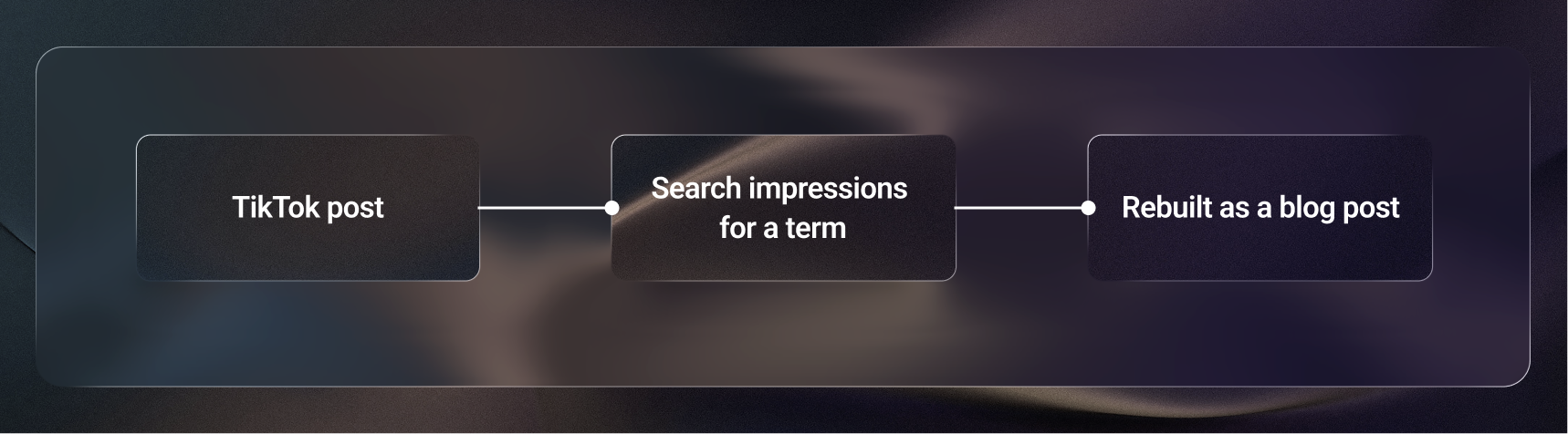
  • When a post earns high impressions for a specific term, don’t just note it and move on. Rebuild that idea as a proper page or video on your own site. A TikTok quietly ranking for “best budget skincare routine” is telling you exactly what your next blog post should be about.


Strategy and reporting level:

  • Stop reporting social and website search performance in separate decks. Pull both into one view, so anyone reading it can see total search-driven demand for a topic across every channel your brand shows up on, not just the website slice.
  • Export the click and impression figures and use them as a direct line in budget conversations – not “social is doing well,” but a specific number of clicks a given account generated from Google Search last month, and what that would have cost to buy through paid search instead. That’s the kind of evidence Brand Is Demand Gen in B2B argues most budget conversations are missing.
  • If a TikTok or Instagram post keeps earning clicks from Google Search for the same topic, that’s real evidence people are searching for it – not a guess, a data point. Take that topic and build it out properly: a website page targeting the same term, a paid search campaign around it, another video covering it in more depth. You’re not chasing a trend. You’re following proof of demand that already exists, rather than guessing what to create next.
  • Match content format to what’s actually converting in search. If a 30-second TikTok is earning clicks for a topic but a 10-minute YouTube video on the same subject isn’t, that’s telling you something about the format the search intent actually wants – not just the topic.
  • If you work with creators or influencers, this data finally lets you ask a question you couldn’t answer before: is the sponsored content they’re posting earning genuine search visibility, or just views and engagement that disappear once the post stops circulating? That reframes creator spend as something measurable in search terms, not just reach.

Process showing Tiktok post getting impressions in search - using this to inform blog strategy


Your website was never the whole picture. Now you've got proof.

For years, social’s contribution to search was something you sensed but couldn’t show. Google reporting on it doesn’t create that value – it just means you can finally point to it. Verify the properties, pull the query data, and use it the way it’s meant to be used: as evidence, not decoration.

That’s how we build search strategies at Invanity – accounting for every channel your brand shows up on, not just your website. If you want a search strategy built for where visibility actually lives now, we’ll build it with you.

Francesca Hume
LinkedIn

Francesca Hume

Francesca makes brands easier to find and harder to ignore. She keeps search and paid channels tuned to client goals, turning visibility into pipeline and pipeline into revenue.