Before we explore solutions, we need to understand the problems. These aren’t minor adjustments – they’re fundamental shifts that will affect everything from how you measure success to how customers discover your brand.
The challenges fall into several key areas: increased competition favouring established brands, reduced website traffic, measurement difficulties, fewer conversion opportunities, and loss of control over content presentation. Each creates a domino effect that could significantly impact your bottom line if left unaddressed.
1. SEO now requires holistic marketing (not just keywords).
SEO is transforming from a standalone keyword optimisation discipline into “SEvO” (Search Everywhere Optimisation) – a comprehensive, cross-channel marketing initiative that requires significantly more resources than traditional SEO ever did.
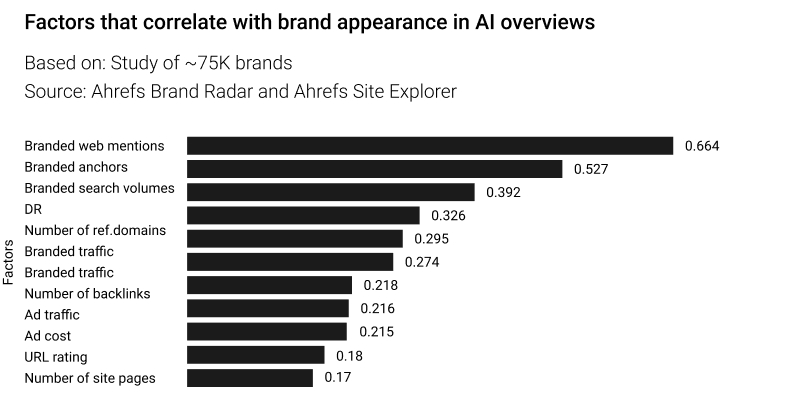
AI Mode seems primed to shift the balance of the competitive landscape in favour of larger or more established brands, creating substantial barriers to entry for smaller businesses.
Established brands get priority.
Brand awareness is already a key factor in SEO. People often learn about your brand through SEO, but purchase through a different channel. When looking at how people first become aware of a brand versus how they purchase, research shows that 33% of consumers discover new brands through search engines.
Google’s AI draws from multiple signals including brand recognition, cross-platform presence, and user engagement history. Larger brands with established reputations and extensive content libraries naturally appear more authoritative to AI systems. Some industry experts have suggested that brands with existing partnerships or closer relationships with Google may get preferential treatment in AI responses (though there is no confirmed evidence of this).
SEO is no longer a standalone tactic.
The shift to “SEvO” demands a holistic marketing strategy that traditional SEO teams aren’t equipped to deliver alone. Small businesses that previously competed through focused keyword strategies now need:
- Digital PR to build authoritative backlinks and brand mentions across industry publications.
- Thought leadership content on platforms like LinkedIn to establish expertise and authority.
- Social media presence across multiple platforms (TikTok, Reddit, Pinterest, YouTube) for brand awareness and social search.
- Video marketing on YouTube, given it’s the single most cited domain by LLMs.
- Content across multiple formats – blogs, podcasts, videos, social posts, all working together.
- Entirely new skill sets spanning PR, social strategy, video production, and content marketing.
This represents a fundamental shift from SEO as a technical discipline to SEO as an integrated marketing function requiring substantially more budget and resources.
Reduced discovery opportunities.
AI Mode relies on existing user signals and behaviour patterns. If someone hasn’t previously engaged with your brand through Google’s services, the AI might not consider you relevant enough to include. The result is a chicken-and-egg problem, where new brands are going to struggle to gain initial visibility, which will make organic discovery extremely difficult, which will limit visibility, etc.
Brand awareness is already a key factor in SEO. People often learn about your brand through SEO, but purchase through a different channel. When looking at how people first become aware of a brand versus how they purchase, research shows that 33% of consumers discover new brands through search engines.
This level of awareness has always been crucial for SEO success, but AI Mode intensifies the dynamic. With its preference for established brands, businesses that aren’t visible on AI Mode could end up losing a third of their awareness opportunities.
2. Reduced traffic and upsell opportunities.
AI Mode will significantly reduce website traffic whilst eliminating critical upsell and cross-sell opportunities that drive revenue.
AI Mode answers queries directly without requiring users to visit external sites. Research shows that approximately 93% of AI Mode sessions end without any visit to a website, with roughly three out of four users never leaving the AI Mode pane at all. AI Mode’s referral rate sits at just ~2%, compared to 17-19% for traditional Google Search. With over 100 million monthly active users and Google planning expansion to 20+ languages by the end of 2025, the era of abundant organic traffic from search is clearly over. You get citations but no visitors.
The death of the traditional funnel.
This compressed funnel eliminates crucial touchpoints – no opportunity to upsell, cross-sell, or convert casual browsers. Traditional user journeys that showcase products, capture emails, and build trust are lost when users get answers directly from AI Mode.
When visitors do reach your site from AI Mode, they’ve already completed much of their research within Google’s ecosystem, bypassing the awareness and consideration stages where you would typically:
- Demonstrate your unique selling points.
- Further educate and impress visitors/prospects.
- Showcase related or complementary products.
- Offer product bundles or upgrades.
- Capture email addresses for nurture campaigns.
- Present limited-time offers or discounts.
- Build brand affinity through storytelling.
- Gather valuable first-party customer data.
Agentic commerce: The complete loss of customer touchpoints.
E-commerce faces an even greater threat with Google’s new agentic commerce capabilities, announced in January 2026. Through the Universal Commerce Protocol (UCP) – an open standard developed with Shopify, Etsy, Wayfair, Target, and Walmart, and endorsed by over 20 major brands including American Express, Mastercard, Visa, Best Buy, and The Home Depot – Google has fundamentally transformed online shopping.
Users can now track prices on products and set preferences for size, colour, and budget directly in Google AI Mode. When prices drop, they can tap “buy for me” and Google will complete checkout using the Universal Commerce Protocol via Google Pay without the user ever visiting the retailer’s website.
Additionally, Google’s Business Agent feature (launched 12 January 2026) allows shoppers to chat with branded “virtual sales associates” directly in search results. Retailers like Lowe’s, Michaels, Poshmark, and Reebok can now provide product consultations entirely within Google’s ecosystem.
Through the Direct Offers pilot, retailers can present exclusive discounts directly within AI Mode conversations, with Google’s AI determining when offers are relevant to display.
This represents a fundamental shift for e-commerce brands. The entire purchase journey – from discovery to transaction – can now happen within Google’s ecosystem, meaning businesses lose control over the shopping experience entirely. There’s no opportunity to:
- Showcase related products or accessories.
- Offer product bundles or volume discounts.
- Build brand relationships through storytelling.
- Gather customer data or shopping preferences.
- Present loyalty programme benefits.
- Capture emails for post-purchase nurture.
- Create memorable checkout experiences.
- Encourage account creation for future purchases.
For online retailers, this could mean receiving orders without any direct customer interaction or brand engagement whatsoever. Merchants remain the seller of record, but lose virtually all opportunities for customer relationship building and data collection.
3. You can’t track what you can’t see.
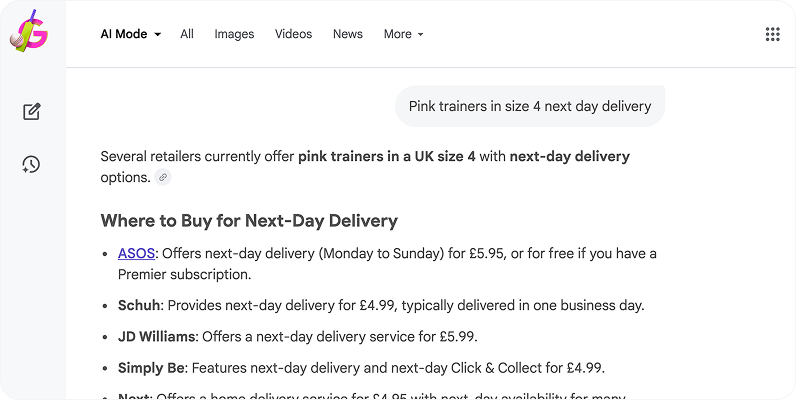
The gap between how often your content is cited by Google AI Mode versus the number of clicks you receive creates a fundamental measurement challenge that makes optimisation nearly impossible.
Even if your content is appearing constantly and influencing purchase decisions, there’s no reliable way to track this (for now). Google has said that, though these clicks will be fewer, they will be more intentional – but without proper tracking, proving ROI becomes increasingly more challenging.
The attribution black hole.
Whilst there are tools that track brand mentions, citation frequency and competitive share of voice on AI Mode, they cannot show you exact traffic from this channel. Tracking is improving through Search Console’s generative AI reports, but prompt-level, conversion-level and GA4 attribution remain incomplete.
This creates a fundamental attribution problem. You can’t A/B test AI Mode strategies because you can’t isolate the results. This makes proving the value of AI optimisation efforts extremely difficult, especially when trying to justify increased budgets to stakeholders.
Traditional tools become ineffective.
Keyword tracking tools become worthless due to highly personalised AI responses. Logged-out rank tracking data bears little resemblance to what real users see. The personalisation means that two users asking the exact same question might receive completely different AI responses, making traditional position tracking meaningless.
4. Loss of control over context.
AI Mode doesn’t just display your content – it interprets, synthesises, and recontextualises it alongside information from multiple sources, often in ways you cannot predict or control.
The wolf river electric case: When AI gets it wrong.
The Wolf River Electric case demonstrates the severe consequences of losing control over context. In 2024, Google’s AI Overview generated false claims that this Minnesota solar company was being sued by the state Attorney General for deceptive sales practices – a lawsuit that never existed. The AI cited legitimate news sources, but fabricated causal connections between them, creating a convincing but entirely false narrative.
This was an issue with Google’s AI Overview, not AI Mode, but it is a problem that all LLMs and AI citations face.
The AI Overview stated: “According to recent news reports, Wolf River Electric is currently facing a lawsuit from the Minnesota Attorney General due to allegations of deceptive sales practices regarding their solar panel installations, including misleading customers about cost savings, using high-pressure tactics, and tricking homeowners into signing binding contracts with hidden fees.”
The result? Customers terminated contracts worth $39,680, $150,000, and more, citing the false Google AI claims. Wolf River lost an estimated $24.7 million in 2024 alone, leading to a defamation lawsuit seeking $110–210 million in damages.
The AI Overview cited four real sources – including a Minnesota Star Tribune article and an Attorney General press release – but none of these sources actually stated what Google’s AI claimed they did. The Star Tribune article mentioned Wolf River at the end of a story about other solar companies being sued, but never said Wolf River was included in the lawsuit.
The broader implications.
This isn’t just about misrepresentation – it’s about AI systems creating entirely new narratives by synthesising information in ways that fundamentally mischaracterise reality. Even when companies do everything right with their content, AI can recontextualise it in damaging ways:
- A nuanced explanation about product limitations might be condensed into a simple “doesn’t support X feature,” potentially misrepresenting your actual position or the reasoning behind certain decisions.
- The system might present your product as the “budget option” or highlight a competitor’s advantages more prominently, regardless of how you’ve strategically positioned your brand in your own content.
- Technical specifications might be oversimplified, pricing information could be presented without important caveats, or your brand values might be mischaracterised.
Unlike traditional search results where users see your content in its original form, AI Mode’s interpretations become the primary way users encounter your brand. This dependency on Google’s AI interpretation means that even perfect content optimisation offers no guarantee that your intended message will reach users accurately.