
“Google I/O 2026 confirmed what the data already showed – search is growing, and the winners are the brands AI can cite.”
More from FrancescaGoogle I/O 2026: What the AI Search updates mean for your organic visibility.
What Google’s latest AI Search updates change about how content gets found, cited and acted on – and why search volume is rising, not falling.

Introduction.
Google I/O 2026 made one thing clear: AI Search isn’t a future concern. With a billion monthly users and query volume at an all-time high, it’s already the primary experience for a significant portion of the internet.
This piece is for marketing leaders and business decision-makers who need to understand what that means in practice – not as a technical deep-dive, but as a clear-eyed view of what’s shifting and where to focus.
The counterintuitive point worth holding onto throughout: AI isn’t reducing search. It’s increasing it. People are searching more, not less. The question is whether your content is built for the way they’re searching now.
Note: This article is talking specifically about AI Search within Google – not within LLMs such as ChatGPT, Gemini, and Claude.
The scale of the shift.
Before we get into the implications, ground yourself in the numbers. These are Google’s own figures, from the I/O and GML keynotes.
- AI Mode: one billion monthly users, one year after launch – Google I/O, May 2026.
- AI Overviews: 2.5 billion monthly active users – GML 2026 keynote.
- AI Mode queries have more than doubled every quarter since launch.
- Searches in AI Mode run three times longer than traditional searches on average.
- Total search query volume hit an all-time high last quarter.
- Brainstorming searches – queries starting with ‘ideas for’ or ‘which’ – are growing exponentially.
- 75% of users say they feel more confident making decisions with AI Overviews.
People are searching more because search can now handle the complex, exploratory questions that keyword-based search couldn’t. What has changed is the format of queries, the structure of results, and what makes content valuable inside that new experience.
AI Mode and AI Overviews become one seamless experience.
At I/O, Google confirmed that AI Overviews and AI Mode are coming together into one seamless AI Search experience. A user starts with a question, gets an AI Overview, then flows directly into a conversational back-and-forth with AI Mode. Context carries across the whole session. This is live now, globally, on desktop and mobile.
The commercial implications are worth sitting with. BrightEdge research from May 2025 found that in the year since AI Overviews launched, click-through rates to websites dropped nearly 30% – while impressions grew 49%. Fewer clicks, significantly more visibility. But the more telling finding is what happens when someone does click through: they’re further down the decision journey and considerably more qualified. The AI experience filters early so by the time a visitor lands on your site, they’re further down the funnel.
That changes what being cited in AI Search actually means. Content cited in AI Overviews is now the gateway to a deeper AI Mode conversation – and with that merged experience now live globally, being the cited source matters beyond the citation itself. It’s the start of a qualified journey, not just a mention.
Which brings us to the fundamental shift: AI Search increasingly means being extractable, not just indexable. Getting indexed was the old game. Being interpretable and citable by AI is the new one. This is the core of AI SEO – structuring content so AI systems can interpret and surface it accurately, not just crawl and rank it.
The day after I/O, Google Marketing Live 2026 showed the paid media side of the same shift — with new ad formats, AI Max and AI Brief all built around conversational AI Search behaviour.
The new search box.
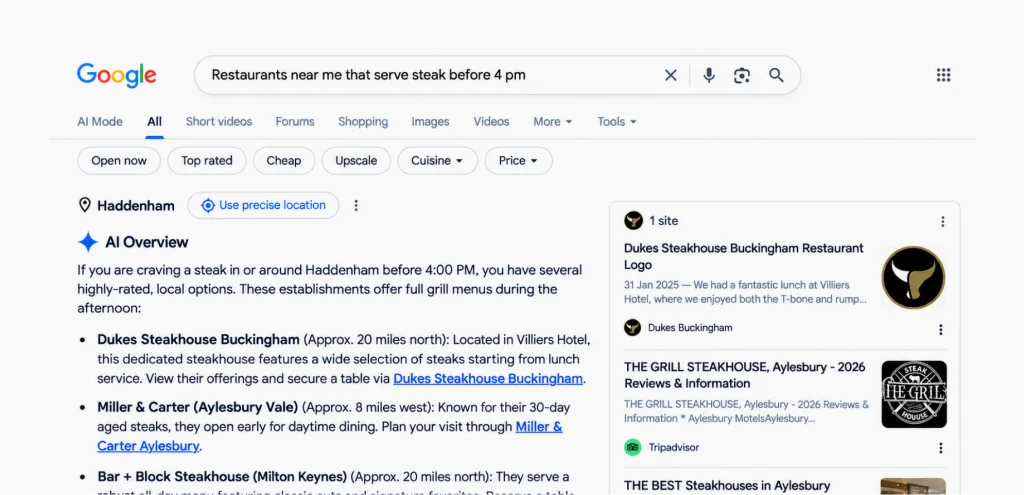
The redesigned search box is a direct response to how behaviour has already shifted. Queries in AI Mode run three times longer than traditional searches on average – people aren’t typing three-word phrases, they’re describing problems in detail, asking nuanced questions, referencing images and files.
The new box matches that: it expands dynamically, accepts text, images, files, videos, and Chrome tabs as inputs, and suggests how to formulate a question well beyond autocomplete.
The queries arriving in your category are getting longer and more specific. In practice, this means:
- Content structured around long-form, question-based queries will perform better than content optimised for short-tail keywords.
- Clear headers, FAQ-style sections, and direct answers to specific questions are more valuable than ever – they’re the signals AI uses to extract answers.
- Thin, keyword-stuffed content is increasingly irrelevant. It’s not just a quality issue – it’s a structural mismatch with how search now works.
Search agents make fresh content more important.
Google launched Information Agents at I/O – background AI agents that monitor the web continuously for updates on topics a user has defined, then send synthesised briefings with the ability to take action. Rolling out June 2026, starting with Google AI Pro and Ultra subscribers. As of September 2026, it remains exclusive to paid subscribers.
In plain terms: a user sets up an agent to track ‘sustainability regulations in the packaging industry’ and Google’s agent monitors blogs, news, and social posts, then sends a synthesised update. It doesn’t surface links. It surfaces conclusions drawn from what it’s read.
What this means for content teams:
- Content picked up by information agents needs to be fresh, clearly attributed to your brand, and crisply structured – agents favour established, credible sources.
- Publishing cadence and content freshness become more significant signals. Dormant content is less likely to surface in an agent’s monitoring sweep.
- Being a recognised, authoritative voice in your niche matters more, not less, as agents become the layer between content and audience.
This section is forward-looking – Information Agents are rolling out, not fully live for all users. But the preparation is the same regardless of the timeline. The brands building content authority now are the ones agents will consistently surface.
Generative UI – search starts building experiences.
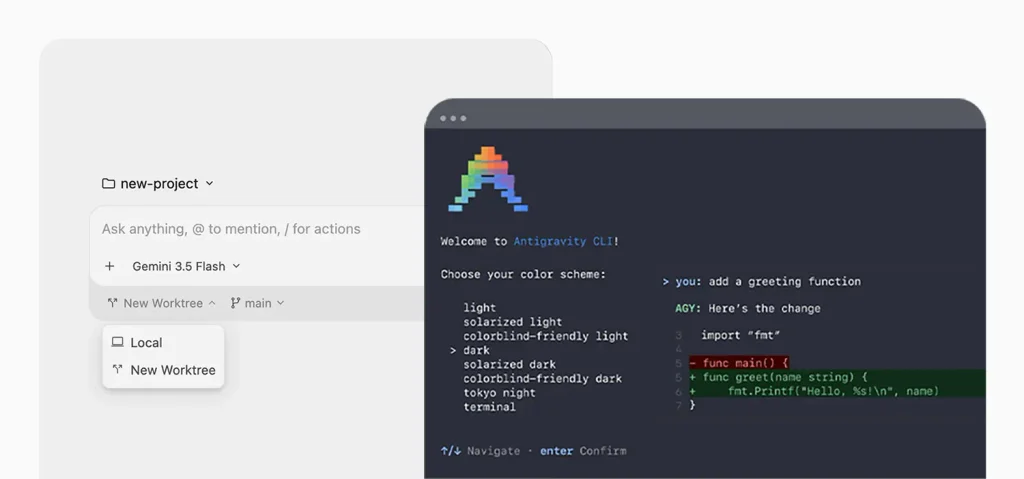
Antigravity, Google’s agent-first development platform, lets Search build custom UI responses on the fly – interactive tables, graphs, simulations, trackers – tailored precisely to the query.
For complex, ongoing queries – planning a wedding, managing a home move – Search can now build bespoke dashboards and trackers rather than returning a list of links.
The SEO implication: for this category of query, the ‘blue link’ result is being displaced. If Search can generate a custom fitness tracker in response to ‘help me build a running plan,’ the content that would have ranked for that query has a different job now – it needs to be the data source the generative UI draws from.
Honest framing: this is early. The full impact won’t be visible in analytics for some time. But it signals a clear direction – content that is genuinely useful and data-rich is more valuable than ever.
What to do about it.
Google search isn’t going away. It’s the most valuable channel for organic visibility that exists. But the optimisation logic that worked for the last decade – keyword research, backlink building, meta optimisation – is necessary but no longer sufficient.
The businesses that win in AI Search are the ones whose content can be understood, extracted, and cited by AI systems. Not just indexed by crawlers.
Three questions worth taking to your next marketing conversation:
- Is your content built to be cited, or just to rank? Clear structure, direct answers, well-signposted headers – if it can’t be parsed into a clean answer, it won’t be surfaced as one.
- Is your content strategy aligned to how people actually search now? Question-led, specific, and built around the complex queries AI Mode is designed to handle – not short-tail keywords optimised for a results page that’s rapidly changing.
- Is publishing a consistent priority, or an afterthought? Information Agents are already monitoring the web. Businesses that publish regularly and authoritatively get surfaced. Dormant sites don’t.
The infrastructure is already there. The question is whether your content is built for it.